Creativity Q+A with Brianne Farley
Brianne Farley takes “silly seriously,” she said. The Traverse City author-illustrator believes “[h]aving fun is very important.” And both of those things infuse the 41-year-old’s work, which involves drawing on walls [aka painting murals] and detailing, in word and picture, how a worm makes a sandwich. Read on. It all makes a ton of sense.
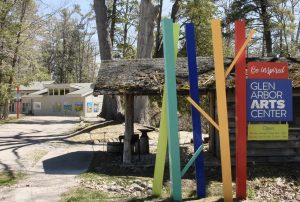
This interview was conducted in June 2025 by Sarah Bearup-Neal, Glen Arbor Arts Center gallery manager, and edited for clarity.
What is your work?
Author-illustrator of picture books.
What draws you to this work?
When I was really young, I thought I wanted to be an author-illustrator. When I got older, I thought a career in the arts wasn’t really practical; I thought I wanted to be an editor. I tried to be practical, so I went to school for English; and I accidentally minored in studio art because I kept on taking art classes. When I was in college [she graduated from Macalester College in 2006 with a BA], that’s when I first discovered printmaking. I thought it was a natural combination of my two interests: Bookmaking and art-with-words went naturally with printmaking.
After college, I got a job at the Art Institute of Chicago as an administrative assistant in the Asian Art department. I got to be around a lot of printmaking there. I could also take classes for free at the School of the Art Institute, so I started taking more printmaking classes, and I also took a children’s book class. That’s where I rediscovered that children’s book were another [avenue] to combining art and writing. A year later, I applied to grad school with a focus on children’s books [she received an MFA in Illustration from Savannah College of Art and Design in 2011].
How does printmaking show up in your work today?
My last couple of books: not as much. My first few books, I found myself thinking in layers. With block printing and screen printing, you’re really thinking of your art in terms of flat layers 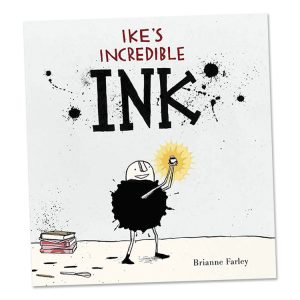 and textures. My first book, Ike’s Incredible Ink, I drew the whole book with India ink and watercolor, then scanned it as a black and white [image]. I also scanned some other papers — pretty Japanese bookmaking papers, dry cleaning tags, scraps from magazines — and then I layered that in behind my ink drawings. It was almost like I was making a digital screen print. Block printing and screen printing lend themselves to this flat, graphic design work. It’s less about perspective, and more about composition. I was also drawn to that style of drawing.
You have eight books for children: three of them you’ve written and illustrated; five are children’s stories for which you created the illustrations. Let’s talk about working collaboratively with another author. What are the challenges and attractions of creating the visual counterpart to the author’s words?
I like the opportunity to be inspired by another person’s imagination, and getting to develop the whole visual world of the book. I’m often drawing things/concepts outside my comfort zone, and it pushes my creative problem-solving skills. 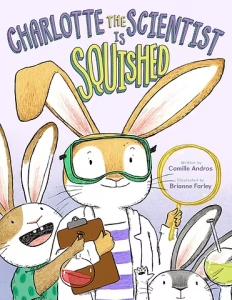 For the book Charlotte The Scientist Is Squished, the author (Camille Andros) wrote something along the lines of “Charlotte tried an experiment to make her siblings disappear, but it didn’t work.” I remember reading that and thinking, How on earth do you draw NOT disappearing?
How is that process different from creating a book based on your own ideas?
For my own books I have more control — I can change the text to make the art work, or I can change the art to make the text work. But that also makes it more difficult. I love that I get to fully explore an idea of my own from start to finish. Something that started as a kind of ear worm, an idea I just couldn’t stop thinking about, is fully explored, deeply investigated through notes and sketches and words and thumbnails and finished art — until years later it’s a real, physical object. Picture books are more like movies than other visual art forms, because you’re working with sequence and time. The first page affects how you (the reader) interpret the next page, and the next. So there’s a real puzzle-solving element — if I make one story-telling choice on one page, it changes the creative choices I make on later pages. Of course, that’s still true when I’m illustrating for other authors. You just have exponentially more options when the whole project is yours.
What role did picture books play in your life as a kid?
I read a lot as a kid. I remember being read-to a lot as a kid. I particularly liked Sneetches and Hop On Pop. I learned to read with those books, when I was 4 or 5.
It was a happy connection to childhood.
Oh, yeah. That’s the magic of children’s books. It’s this cool medium that’s designed to be read out loud. This is a collaborative experience. The child is reading the book with a caregiver, and [the child] is “reading” the book in their lap, or in bed, tucked in and snuggled. It’s a really cool space — a lot of picture books are super silly, and it’s a chance to be silly with their caregiver; or, the story can be about a super serious topic, and it’s a safe space to explore those topics with somebody. I think picture books are magic.
You were a child once. Do you return to your childhood memory banks for story ideas and images?
Right now, I’m trying to write my first novel, a middle grade/early reader novel. When I feel stuck with it, I start writing notes about my memories of first or second grade. For my 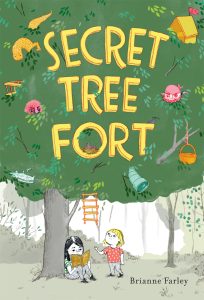 second book, Secret Tree Fort, that one was inspired by my childhood. The book is about a little girl who is trying to get the attention of her older sister, and her older sister has her nose in a book. The younger sister is doing everything she can to get her sister’s attention including [a story] of a magical tree fort that may, or may not, exist. I was a big reader growing up. I tell people that my younger sister had a secret power for knowing when I was reading a book; she could sense it from anywhere in the house, and would come and interrupt me. But one of the things we did like doing together was designing tree houses. We’d draw these super elaborate plans: The jacuzzi will go on the third floor! The zip line will take you right in there!
Adults have to work overtime to access that kind of kid-like thinking. I’ve wondered if it’s a struggle to create a story for kids being an adult?
Definitely. My friends who make picture books, and I, talk about this a lot. We’ll see a picture book that’s incredible; but then you ask yourself: Is this a book for adults? Or, for kids? Is it something kids would actually like? I don’t know if there’s an easy answer to that. Part of me thinks it’s important for children’s book authors and illustrators to be working with their child audience in mind; but the other part of me thinks that kids are very smart, full, complicated people who have a wide variety of interests — depending upon the kid. The other thing that’s important is to just make the best piece of art that you can. If you’re making good art and speaking to these universal truths, the that will be exciting to people of all ages.
You have a kiddo of your own.
I have a son, Oscar, who is not quite 2.
How does that work for a parent who writes and illustrates books that are mostly aimed at kids? Does Oscar get pulled into the process? As a first reader or first responder?
He hasn’t yet. He’s too little. He’s starting to turn the corner into liking longer picture books, but mostly he’s at the age where he likes to point at things and ask what their names are. Most of my books are aimed at 3–7-year-olds; but it’s definitely influencing how I look at the world. Also, reading a ton of board books [to Oscar] has made me want to try my hand at a board book. I do have two nieces [ages 9 and 8] who are local, and — depending how you look at it — have benefited or suffered the consequences of me showing them my early books. 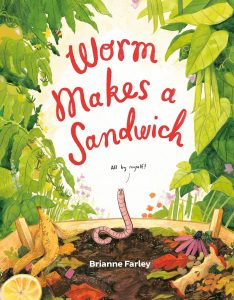 I read early versions of Worm Makes A Sandwich to both of their classes. My oldest niece is a huge reader, and also very interested in bugs. She’s been a good resource. Both of the girls have a fantastic sense of humor, so have been good sounding boards for what’s funny.
Murals are another component of your practice. Why do business owners or homeowners commission you to create a mural? What does a mural bring to an interior space that a painting or two, for example, do not?
For one: scale. Murals are enormous pieces, which is what’s fun for me. Usually, I’m working on something that’s the size of an open book. I’ve only done one private residence. I usually do them for businesses and nonprofits, mostly to try to tell a story or to incorporate a mood into a place. My first mural was for Little Fleet, inside the building, just black line art. They came to me and said they wanted a mural that was loose and fun with a few weird characters. They didn’t want to see any sketches. They told me to just do my thing. At the time I was still living in Brooklyn. I’d just painted my bathroom with chalkboard paint, and had drawn a bunch of weird characters all over my bathroom. So I sent them a photo of my bathroom and asked them [Little Fleet’s owners], Is this what you’re thinking? And they said, Yep! I came to their business, stood on a ladder and just doodled all over the wall. They were trying to incorporate a — I don’t know, I don’t like the word “whimsy” — a sense of playfulness into their space.
In contrast to that, I did a mural for Grocer’s Daughter Chocolate. I met with Jody, the owner, about what the chocolate making process was like. She had just given a class on how cacao is grown. I learned that a huge part of their business model is that they’re tied into the farmers who grow their cacao. That’s the inspiration for the mural, which [illustrates] different parts of the process. That mural was about adding color and life to the place, but also tying in educational aspects that are important to them.
What’s wrong with the word “whimsy”?
“Whimsy” feels twee to me. “Joy” is a better word? I wish there was a better word for describing taking silly seriously. Having fun is very important. Being joyful is an important practice. I feel like saying something is “whimsical” is like writing it off. Kids take play very seriously: Things can be playful and well thought out. That’s the trick of picture books, poetry, really good graphic design: Things that seem simple often have a ton of work behind them.
Describe your workspace.

There are shelves full of books, my own, private collection of picture books that Oscar is not allowed to touch yet. It’s a room in the Tru Fit Trouser Building [in Traverse City, Michigan]. It’s a shared, working space. Semi-private — we have nine-foot walls that don’t reach the ceiling so we can all hear each other talking. It’s great. I have a window. My space is like the size of a spare bedroom.
What’s your favorite tool?
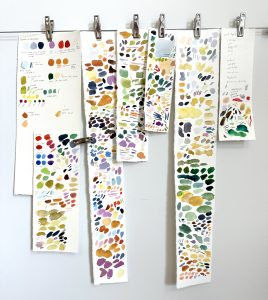
Color swatches. I would work traditionally then finish my pieces on the computers. My last three books, I’ve done almost fully just on paper. I’ve been using gouache, watercolor and colored pencil. The thing I’ve been enjoying and really relying on is color swatches, where I’m testing out my paint as I’m painting. I love how they turn out. It’s like, I love this thing and I don’t know what to do with it. Do I frame this?
The thing about books is, a lot of the time, you have to be super consistent across multiple pieces of art [per book]. I’ll make color palette maps where it says how I’ve mixed each color, and it gives me a reference to go back to.
You said that the last few books you worked on were done by hand. Why is making-by-hand important enough that you continue doing it?
I’ve found that working with my hands is something I’m drawn to across the board: [For example] I really like gardening and physically getting in there with my hand. I think there’s a connection between doing something with your hands and reaching that flow state; where you enter this state of extreme focus, and you’re super present in the moment. I’ve found that I’ve enjoyed my day more on the days when I was able to be working with my hands. I was also a little more playful with my work, I could respond to problems when I saw them: [for example] Oh, this piece needs more contrast, or this needs more energy in the line work. I could respond as I went along; whereas when I was incorporating scanning and computer work, I was getting tight. When you’re working by hand, you have to own your own mistakes: I didn’t mean for that drop of paint to fall there. Well, keep going!
Working by hand is about imperfection. Stuff happens. That drop of paint that fell is an opportunity to come up with a new, creative solution, that kind of spontaneous phenomena doesn’t happen with a computer.
It’s a lot harder working by hand. At its best, the computer is a tool like any other. People are going to use it with the same variety of skill and play. For me, I do my best work and enjoy it the most when I’m working off the computer. Having said that, the next book I’m working on, I’m working on the computer. I draw [images for the story] then scan them on the computer. I get to leave in a little bit of flexibility. I can draw a piece over and over and over again, and then drop it into Photoshop to see which one works best. It removes a step of frustration.
Do you use a sketchbook or work journal to develop ideas in?
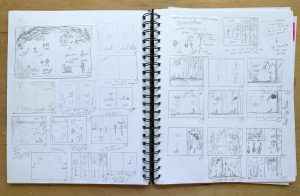
I’ve developed a process that [involves] an index card box. I write book ideas on index cards, and keep them in here. Sometimes the idea won’t leave me alone. Sometimes I forget it’s in there. Then, if I decide I want to work on one of those ideas, I give each book idea its own little notebook.
When did you commit to working with serious intent? What were the circumstances?
I thought that art was my happy place, and that trying to make it be the thing that would also earn me money would take away the joy of it. I’m a little bit right about that. I turned that corner when I was working at the Chicago Art Institute. You could take classes for free at the School of the Art Institute, and also go to Ox-bow [School of Art in Saugatuck, Michigan] to take classes. I went there for a week [in 2008], and took a class called Block Print To Book. It was taught by a woman who was a printmaker and paper conservator for the museum. She was really impressive. The class ran from 9 am to 5 pm, and the studio was open until midnight. I was there 9 pm to midnight, every day, and I was so happy. I came back from that and my parents said, Maybe this is what makes you really happy, and you should consider doing this [professionally].
What role does social media play in your practice?
I used to really love Instagram. Now, I don’t like being on Instagram. It used to make me feel like there was a community of people who made pictures books — especially being in Traverse City, and having left my group of people who made picture books all the time. It felt like a good way to stay connected to them. And, I like recording time lapse videos of me working. It helped me stay focused, and I got real-time feedback on my work. For people who didn’t make art, it was fun for them to see the reality of what went into making a piece of art, how long it took. But I feel like social media has really changed in the last five years, that something has shifted. It doesn’t feel as fun anymore. It feels like you’re being sucked into somebody else’s advertising. That being said, I think there are ways to participate in it in a great way. I just need to find my way back into it.
What do you believe is the creative practitioner’s role in the world?
Creativity and play should be part of everyone’s life. Making things is such a human thing to do, regardless of one’s skill or how the finished product turns out. That’s all irrelevant when you’re playing (or sketching or practicing or whatever you want to call it). Play opens your brain to new possibilities. It is a safe space to try out new ideas and be wrong.
For professional artists, or artists who choose to put their art out in the world, art becomes a conversation. Art draws attention to something the artist sees as valuable, something they think is worth having a conversation about, and it becomes just as much about the person talking (the artist) as about the person listening (the viewer). Artists distill, focus, draw attention. They can help us imagine the world as it does not (yet) exist. That is powerful. Therefore it is our responsibility as artists (and as conversationalists!) to recognize that our words and our art have power — to take seriously the things we are saying and making. I don’t mean we have to BE serious, or that our art has to BE serious. I just mean, it’s our responsibility to be truthful and thoughtful about the things we say and make and then choose to put into the world.
How does living in Northern Michigan inform and influence your creative practice?
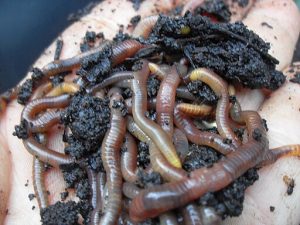
In some ways it has been tough. I’m really lucky this is a super creative place, and there are a lot of full-time artists. There aren’t a lot of people who are full-time picture book author-illustrators. I do miss that group of friends and collaborators. But my lifestyle here is influencing my work. For Worm Makes A Sandwich, which I wrote by accident because I’d just gotten into vermicomposting and gardening. They became passions. I’d show up at parties and want to talk about worms and compost. People asked if I was researching a book. Finally [she asked herself], Should I work on a book about this?
If you still lived in New York City, you wouldn’t have written that book.
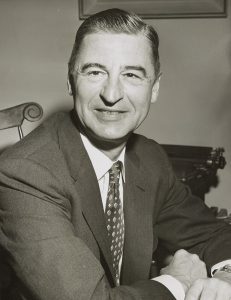
Right. I’d be writing a different book. I was working at Random House [as a freelance junior designer] when I was still in New York — my first boss was Dr. Seuss’s art director. I sold my first book when I started my job there, so I was always doing two jobs at once in New York. When I was thinking about moving back here, I realized I could probably write and illustrate full-time because the cost of living [was less than in NYC]. It felt more like the lifestyle I wanted. I thought about where I’d like to raise a family.
Did you know anyone, when you were growing up, who had a serious creative practice? Somebody who would have been a model for you.
My parents were both creative. My mom owned a framing gallery outside of Chicago, and kept it for a few years when we moved here. I remember being around art, and art being a business. My dad makes surgical instruments. He’s a business owner but also did a lot of research and development. He’d drive me to the school bus at 6:45 am. We’d sit in his car in the pitch-black, and he would tell me about projects they were working on. I’d try to give him my little solutions. I felt like that was a creative job where you had to picture [solutions] in your head.
Who has had the greatest and most lasting influence on your work and practice?
When I was in fifth grade we had to write a speech about what we wanted to do when we grew up. I said I wanted to be Roald Dahl and Quentin Blake combined; in most Roald Dahl books, Blake is doing the illustrations. I remember reading my first Roald Dahl book [The BFG], and said, I want to do this. I keep on coming back to this: It felt like he took being ridiculous super seriously. It was inspiring. Blake’s illustrations were very playful, and made the character jump off the page.
Where or to whom do you go when you need honest feedback about your work?
My five closest picture book author/illustrator friends. We all met in Brooklyn in 2011. Some of us have since moved, but we still talk weekly.
How do you feed and nurture your creativity?
I try to take breaks. And I try to recognize that the things I’m doing outside of my creative practice are also part of my creative practice, and to pay attention to those things; to give myself space and not think of them as wasted time. If you’re an author and you spend all of your time reading books and writing, then all of your books are going to be about writing. You have to go out and have experiences, and pay attention to those experiences. I also like teaching and taking classes. Both those things really fill your creative hub. Teaching forces you to ask why you do thing a certain way; trying to explain this to someone else loosens up your brain. I try to take classes that are outside my comfort zone.
What drives your impulse to make?
Just being a human. It’s how we learn about the world, how we learn about ourselves, maybe even how we try to show who we are to others? Right now a lot of my making is driven by deadlines and contracts, and being paid to make things provides structure and time and motivation. But I’m looking around my desk right now and it’s littered with things I made just because. On my bulletin board is a weaving I made by cutting up a painting I didn’t like. There’s a crying ghost I drew while on the phone with a friend. There’s a motivational totem I made in a class I took just because — in fact it was a class I took when I really, really didn’t have time to take a class. One of my favorite childhood memories is this game I played with my sister. We would go into the woods and separately make little sculptures or inventions, and then trade them with much solemnity. I think it’s just a way of connecting with yourself and others.
Read more about Brianne Farley, her murals and books here.
Sarah Bearup-Neal develops and curates Glen Arbor Arts Center exhibitions. She maintains a studio practice focused on fiber and collage.