Creativity Q+A with Beth Bricker
Once upon a time, Beth Bricker, 64, thought she’d be a rock star when she grew up. But, as career paths go, this one wound around in another direction: It brought her back home to Leelanau County. Beth put down her guitar, picked up the paint brush and continued the family tradition: She became a visual artist. And then, another path appeared, this time involving paint, paper, and lots of glue.
This interview was conducted in April 2026 by Sarah Bearup-Neal, Glen Arbor Arts Center gallery manager, and edited for clarity.
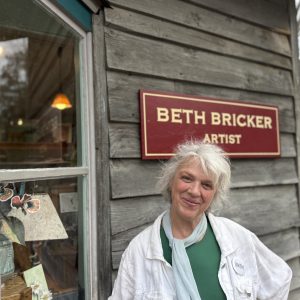
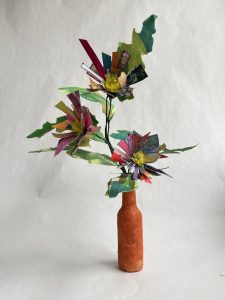
For many years, painting — acrylic and watercolor — was the focus of your practice. At some point, you began to incorporate collage into your paintings. And now, you’ve brought both disciplines together, and are using them to create small sculpture. Your sculptural subject is flowers. Talk about the ways you create these objects.
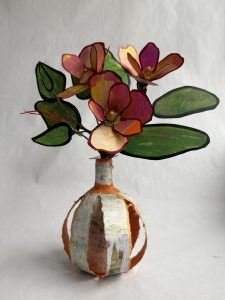
In an historical sense, it’s true: I have been a painter. I’ve always done [other things], birthday cards, and that was collage. The idea of using painted papers in collage came simultaneously from having a lot of works on paper, and [feeling] despondent about that because if you want to share [those paintings], you have to frame them. And [Leelanau County artist] Margo Burian is doing painted-paper collages where she’s intentionally painting paper — her papers aren’t as frantic as the ones I made; they’re solid colors — but her work inspired me to try tearing them up and seeing what happens. It’s hard to remember how I started making flowers. I’d been making papier mache birds. All of the birds are paper sculpture, layering up papers, seeing how the papers move, bending [the papers] a little bit, and that’s what started me thinking about how the [process of making the birds] could be flowers and petals.
Define “painted paper.”
When I’m painting papers specifically for sculptural purposes, I’m using a rubber scraper. I’m choosing the colors and I’m layering them on a piece of paper. Then I pull them [across the paper] with the rubber scraper. I paint my initial papers that way, and then I tear them up, and I add printed papers that I buy. Also, newspapers and magazines. I collage all that onto a larger piece of paper, which I fold in half so it’s two-sided, and then, that is what I cut into for the petals.
You also said you have a pile of paintings, which you dig into, cut up, and use them in your collaging and sculpture.
I do mine those, but it has been a couple of years now. I had a bazillion paintings; I only have half-a-bazillion now. You have to also think about [which of these paintings] is precious, and get over it, and tear it up anyway.
Because of the nature of your making — which is collage and paper mache — you’re not striving for botanical fidelity.
Not even a little bit. I’m not looking to recreate something that exists. There’s an element of playfulness, and outside-the-box creativity I really like. But I don’t find them whimsical. They’re not a caricature of a real thing. They’re something else. They’re a re-think of something that really exists. Right now it’s spring; I’m dying to get out there and look at the spring wildflowers. I’m very inspired by wild flowers, particularly because no one has messed with them.
No one has messed around with their genetics?
Bingo. Exactly. I guess, what I’m doing, is genetic engineering.
When you get out in the woods today, and walk amongst the flowers, what are the things that you’re looking for? If you don’t seek botanical fidelity, then how does this walk work in your process?
There’s two elements in that. One is engineering. One of the things I’ve struggled with, and then when I figure it out I get really proud, is how to physically get [the pieces] to go where I want them to go, and look how I want them to look; but stay that way, long-term. Paper is challenging. So I look at [real flowers], and see how things work: Reality has a million years to figure it out.
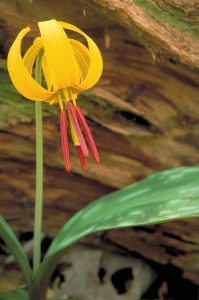
The other is, in a purely sculptural form, I’m looking how the light reflects in the petals. Today, I’m going to try to find some Trout Lilies, they’re early and might be up. You might think it’s an orangey-yellow petal, but if you really look at it there’s 18 billion colors in there, and I like to see how the light and shadow change that.
Let’s talk a little bit about the word “sculpture.” You make a point to say that these things you create are sculptural objects. Like so many of these words that have come down through time, people have developed fixed ideas about what a sculpture is. What you’re making is not bronze, it’s not cast, you don’t take a chisel and remove material — those are the three, big characteristics of conventional sculpture.
One of the reasons why I really like to use that word is to elevate what I’m doing, and I don’t think that’s dishonest. There’s this traditional line between fine art and craft. And, fine art gets, Woooo! We’re so puffed up about you! And craft is like, Isn’t that a lovely hobby.
Sculpture, if viewed under the lens of fine craft, is taken with a great deal more seriousness than objects that are regarded as “craft.” How do you blow that up?
If we take the phrase “fine art,” “fine — that’s a judgement, so let’s do the judging ourselves. My mom [the late Ananda Bricker], for the entirety of my life, sat in the basement and took this little wad of mud — clay — and made it into a shape, and stuck [many of these] shapes together, and, thusly, was making sculpture. So, I’m doing exactly the same thing only I’m using glue and paper.
These flower you’re making aren’t your first foray into flowers that are sculptures. Give us the brief history of that story.
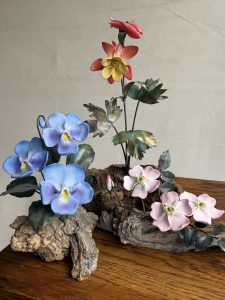
In the early 70s, my mother started making flowers out of porcelain. A few years later, my sister [Cherrie Stege] joined her business, [and they sold their work at] art fairs and wholesale. Cherrie did copper work, and then flowers were copper and porcelain wild flowers. And then, a few years later, I joined them, and I painted them. The business was Forest Flowers, and Forest Gallery [the Glen Arbor gallery Beth owns with her sister, part of Lake Street Studios] is a direct descendant of that. Forest Flowers got a lot of attention and they were wonderful. People all over the world bought them, collected them, and took them very seriously.
Forest Flowers were flowers that were specific to this part of the world.
Yes. Botanically correct, Northern Michigan wild flowers. Very. Specific. In 1993 we had an account with the Smithsonian catalog — we did our online shopping in catalogs then — and we had a relationship with them for five years. Their first order from us was for 500, three-flower [Blue Flag] Irises, which was more work than we’d ever done. It was astounding. I remember the year because I was pregnant [with her second child]. It was a lot of work.
Your mother was a practicing artist. Your Aunt Barrie, her sister, was a practicing artist. Your maternal grandparents were both practicing artists. You come from a long line of practicing artists, mostly people who painted. Who are these people?
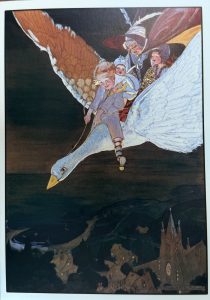
My father [Ben Bricker] was an art professor [at Western Michigan College] in Kalamazoo; and a potter, and a silversmith, and a blacksmith. He was very much interested in the crafts. My mother’s father [Frank Dillon], who was the one who got us here [to Glen Arbor] in the first place — he bought land on Little Glen Lake in 1907. He was an art instructor at the Chicago Art Institute. His wife, Alice, was an illustrator, and did, primarily, nursery rhymes and fairy tales [reproductions of which are sold in Forest Gallery].
What do you feel you inherited from all those people, all that creativity that came down through the gene pool?
Everything. Identity. We’ve identified for generations as artists. Culturally, politically, there’s a whole lot of weird and wonderful identity stuff that comes with that. My mom said, We’re the artist class. We don’t have to think practically like everybody else — which gets you into a lot of trouble.
That’s an interesting statement your mother made. It suggests a world view of total immersion in her creative practice.
Identity. It is, in fact, who I am. We just finished up our taxes, and I’m still saying I’m an artist on the IRS return where they ask you, What’s your profession?
I don’t know what else you’d put there. Being the co-owner of a gallery is kind of a side gig.
Forest Gallery opened in 2006. It transformed. It had been Forest Flowers Showroom, and we showed … If you were related to me, we’d show your work in there. So, it was my mother’s paintings, sometimes my paintings or things that I made, my sister’s things [copper work], my aunt’s things [Barrie was a watercolorist]. Back to that legacy question: What I learned from my family about how you make money is that you make something and you sell it. That just seems to be the way I’ve always done it.
The thing I find so interesting about Forest Gallery is its evolution over the years. It operates on the philosophy of the Arts and Crafts Movement: that no object is too common it should not be beautiful. All the work in Forest Gallery — from switch plates to vases — are in that spirit.
We started incorporating other peoples’ work from all over North America that we were excited about, and embraced those ideals of handmade: out of materials you understand, by people you know. That encapsulates a life philosophy. The American Arts and Crafts Movement was based on the British Arts and Crafts Movement, which was a direct screw-you to the Industrial Revolution. We’re still trying to keep our lives real and not A.I.
We are in a very critical time. We need to go back to those American Arts and Crafts Movement beliefs and practices, and revisit them. Everything we see, practically, in stores, is made by somebody else’s machine in a universe far, far away. But one of the very engaging things about Forest Gallery is you can tell, without even asking, that these objects have human fingerprints all over them.
And it’s so exciting. Yesterday I got an order from Thomas Spake, a glassblower in Tennessee. I like pulling these beautiful, wonderful, exciting things out of their packaging.
And, like the flowers you are now sculpting, not one of these pieces of art looks like the other one you pulled out before. Each one has its own, distinct character.
Lately, you’ve been incorporating handcrafted vases as part of your composition. Talk about that.
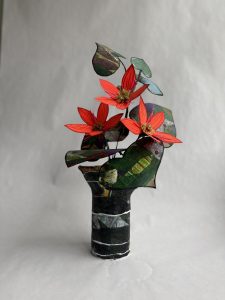
I started making flowers, and I put those out, and they sold. Then I realized: leaves. I need to make flowers and leaves. And this year I realized I needed a full presentation. You, the consumer, need to be able to pick this up and put it on a shelf at home, and call it done and beautiful. You don’t have to think about what kind of vase it has to go with it, or anything like that. I’ve had a hard time coming up with something that looks congruous, but weighted enough — the flowers are heavy and just fall over. So, I figured out how to make vases, and they’re part of the composition.
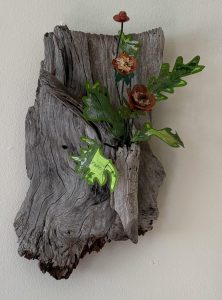
NOTE: About the vases she’s creating for her sculptures, Beth adds this: I have been using glass bottles built out and reshaped with papier mache, and then I do something arty on top of that. Since our conversation I collaborated with [Leelanau County artist] Naomi Call on wall pieces of paper flowers on her driftwood sculptures. So far this is the best presentation of them. Amazingly reminiscent of forest flowers with a contemporary flair.
What’s your favorite studio tool?
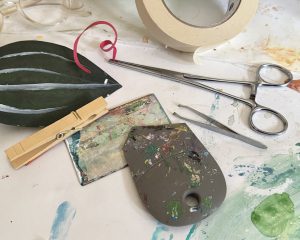
I’m really into this scraper. It’s a really fun tool. As far as the flowers are concerned, I think another favorite tool is tweezers. The whole gluing of the flowers is tricky, and requires tweezers. You can’t get your fingers in there.
Do you use a sketchbook? Work journal? What tool do you use to make notes and record thoughts about your work?
Currently I have five. That comes and goes. I always have two. Right now, I have a couple of sketchbooks. I have something I write poetry in. I have a [personal] journal that I write in, but not daily. And then I have my Artist’s Way journal.
Do they all work together somehow?
Yes. There’s a lot of crossover. I was looking for a painting I’d done [in one of the sketchbooks]; I had some people I wanted to show it to, and it took me a long time to find it. It was in a done-sketchbook that I’d filed away. Organized, I’m not.
Why is making-by-hand important to you?
I feel like having something come from within, that is organically yours, is the point. It’s authentic, and what can we have but that?
When you’re making with your hands, do you ever recognize that you’re feeling something? Is it a joyful experience to cut with scissors, glue things, move the paintbrush around.
I really love it when I can see the work. I, too, love it when I’m looking at somebody else’s work and I can see not only the work and the labor that went into it, but that creative idea or unexpected inspiration. When I’m working, and have a quirky idea that would be fun to try and it works — that’s really thrilling. There is a satisfaction, and I think it come of being 64 and having done this type of work forever. I’m good at it.
There’s nothing that replaces practice.
Right. You can’t start there. You have to get there.
When did you start working with serious intent? What were the circumstances?
When I was in my 20s, I was working with serious intent, and I was going to be — forgive me — a rock star. I was doing performance and installation, and at one point, I got really scared and I gave up. I came home, here, and I’m still here. Then I did that whole 15, 17 years of Forest Flowers. That was serious intent, but I didn’t feel that it was creative. I painted the flowers with an air brush, [but] I was making — painting — widgets. A couple of things happened in my life in the early 2000s. One winter, my husband left; my eldest child went to college; and my mom became incapable of functioning because of her Alzheimer’s. That was when the weight of the world fell on my shoulders. That’s when I started Forest Gallery, and started selling my paintings for money. Not that I wasn’t making money before [from her art], but I’ve always had a side job — selling dresses or pastries or whatever.
Back to being a rock star: What was the thing that scared you so that you walked away from it?
Self-esteem. Confidence. I regret not being brave enough. But I didn’t, and I can’t lament that. That winter, when everything went down, one of my proclamations was to practice being brave. That’s when I started hosting the Manitou Music Festival concerts [a Glen Arbor Arts Center concert series that took place at Lake Street Studio’s stage]. That really worked, and now you just can’t get me to shut up.
What kind of music were you making when you were working on being a rock star?
I played guitar — singer-songwriter-y sorts of things. Mostly, I was working with poets, and incorporating music and movement and visuals into a performance.
What role does social media play in your practice?
Currently not much. We’re trying to get some photographs of my flowers to put on a website. I have been hesitant to put them out there to the whole world — once you put something on the internet I know that somebody from somewhere in the world is going to copy my flowers. I don’t want that to happen, but I have to put myself out there and see. I don’t have a lot of options.
What do you believe is the creative practitioner’s role in the world?
I have a hard time believing that everybody’s not creative. If you don’t feel like you’re not creative, that means that you just haven’t recognized what you’re doing creatively; you just call it something else. But I do think people need to know it’s a possibility that you can live a creative life, according to your principles. It’s hard. It’s important being a creative person and having that reliance on one’s self.
How does living in Northern Michigan in general, and Glen Arbor in particular, inform and influence your creative practice?
It’s really lovely around here, year round. I want to say I need that, but I’ve always had it: I take it for granted. — that it’s going to be beautiful, and within three minutes I can be looking at the water [Lake Michigan]. That’s really important for me to live near the water, and I do live near the water. The water is affirming.
Who has had the greatest, and most lasting influence on your work or practice?
I’m going to have to say my mother. The modeling I saw when I was coming up was what you do for work is you sit in the basement, you make things, then people come to you, and you direct the world from there. I think I’ve always been trying to recreate that in my life, and it’s kind of what I have now.
You’ve figured out your own interpretation of that.
Yeah, and I don’t have a basement. Can I just say that our basement in Kalamazoo — and our house was built on a hill — the basement had windows that looked out over a ravine, and it was lovely. But it was still the basement.
To whom do you go when you want honest feedback about your work?
That gets me into trouble. I do ask people sometimes and I’m never happy with what they say. I would really like to have someone who is my mentor / go-to person, but I haven’t come up with anybody yet. Ab is my daughter, who I live with, and she can be really brutal, but I do go to Ab and say, What about this? Ab will say, You need to take one or two more passes at that or You’re not quite there yet, and she’s usually right. So, maybe, Ab is my person.
How do you feed, nurture, and fuel your creativity?
I get inspired by seeing what other people are doing, and I do that online, and as much as I can in person, which isn’t a lot. I generally get up really early, sometimes as early as 4:30 am, and when I get up in the 4-5 am realm, I’ll make my coffee and sit down at my work bench right then. And, I just start doing. The doing is the fueling, and it’s a lifestyle more than an activity.
What explains your impulse to make?
I think I have a singular view — we all do — but I’ve worked this far to get [her view] out of here [points to her chest], [to being] something that I can show you. I think it’s important — knowing that everybody isn’t the same, and that we all have our own view, and it’s all valid, and here’s mine.
Read more about Beth Bricker and Forest Gallery here.
Sarah Bearup-Neal develops and curates Glen Arbor Art Center exhibitions. She maintains a studio practice focused on fiber and collage.