Creativity Q+A with Harvey Gordon
Leelanau County artist Harvey Gordon, 84, inaugurates the Glen Arbor Arts Center’s 2026 exhibition season with a small exhibition, aptly titled Small Accomplishments [opening January 5]. In this edition of Creativity Q+A, Harvey talks technique and intention, and offers up a poem from which the exhibition’s title stems.
This interview was conducted in October 2025 by Sarah Bearup-Neal, Glen Arbor Arts Center gallery manager, and edited for clarity.
Pictured: Harvey Gordon Self-Portrait. Photo/Harvey Gordon
Small Accomplishments
My name is Life, but don’t confuse my name
with me: a man of little note and small
accomplishments. The train of greatness came,
paused, and pulled out without me. After all
the years and years, my efforts brought me just
a long, full, happy visit to a world
that ground my self-importance into dust
in this vast bowl where pearls and swine are swirled.
What, in the end, has weight enough to stay,
except such small accomplishments as may
reflect experience, formed by the will
and force of human spirit, weak but still
unfailingly alive? Their flames help light
the days and burn through the dark, endless night.
Harvey Gordon | 2025
***************************************************
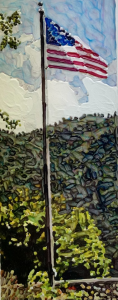
“Ever since I started looking at art, I’ve had a special affinity for small work; work that you could get up close to and see the whole thing, and how it was done,” Harvey Gordon said. The acrylic paintings in Small Accomplishments offer an intimate view of the artist’s process and technique — his signature practice of layering one transparent color on top of another, which he applies to a range of subjects: beach walkers, the American flag flying in front of a business, Sleeping Bear Bay.
Small Accomplishments is a series of paintings that span a particular time period?
I don’t have an answer for that question because I don’t date my paintings.
Why don’t you date your paintings?
First of all, it doesn’t really matter to me when I painted a painting. It’s done, and that’s all I care about. But I did have a conversation with a dealer once, many years ago, and she said, Don’t date your paintings. She didn’t want someone to come into the gallery and look at a painting, and said, Oh no, that was done two years ago, I want the latest model. I wasn’t dating my painting before that, and haven’t done it since.
Talk about the “small” part of Small Accomplishments.
Ever since I started looking at art, I’ve had a special affinity for small work; work that you could get up close to and see the whole thing, and how it was done. That was an important aspect to me. When I look at a painting, there are two things I look at: I want to see the whole painting; and I want to get up close to involve myself in the process of how it was done. With a small painting, you can do both simultaneously. With a big painting, you have to keep going back and forth. Plus, there’s an intimacy with a small painting. You can take it in your hands, put your arms around it.
You were trained in oil painting, but have worked primarily in acrylic.
In the 1960s, when I did my academic training in art, nobody taught anybody anything. The teachers did nothing. The students learned nothing. There were no guidelines: Be yourself. Let it all out. Personalize it as much as possible. I wanted to learn how to paint, and I admire people who know how to paint. I don’t feel like I was trained by anybody. There was no discipline. There were theories. But I learned, first, from looking at books, and I took every opportunity to go to galleries and museums, to look and learn.
What sold you on acrylic painting?
When I was working in oil and looking at paintings, I began to see and feel that I could do a better job with color by glazing colors — putting one color transparently over another — that that would add something interesting to my paintings. If you’re trying to do that with oil, it takes so long to dry: If you put [one color layer] down, you have to wait hours, days until it’s completely dry before you put something over it, but you won’t get a glaze but a mixing of one color into another. I was after the transparency. Acrylics were new then. I was told by a teacher they dry fast, they’re durable, why don’t you give them a try, and I did. It worked for glazing. The paint dries almost immediately. You can put another color over it. That’s why I began to work with acrylics, and, basically, I never looked back. I wanted to be able, literally, to see each brushwork that goes into a painting, and by using transparent layers, it’s possible to accomplish that.
Why do you want to see the brushstrokes? That goes against the classical academic dictum that brushstrokes should not be apparent.
When I look at a painting, I want to know and see everything I can about it. I want that for myself, and I want to give that opportunity to people who see my paintings.
What theme strings together the paintings in Small Accomplishments?
I don’t think in terms of themes. I’ve been painting for 65 years. I can look back at my work and see certain themes or subjects that recur. But they do that because they’re in my life, they draw my attention, they touch me in some way, they affect me and make me want to paint them. Certain themes recur, but there’s nothing deliberate about it. I try to keep it spontaneous as possible; I don’t want to intellectualize it.
You work with five tubes of paint. Total.
Black, white, and the primary colors of red, yellow and blue. If you have those three [primaries], you can mix theoretically and any other color that exists, therefore: That’s all you need.
You could purchase any color you wanted from an art supply store. Does that intrigue you?
What interests me in my own work is being able to see not just the brush marks, but the layers of color that go into creating the color you’re seeing. I don’t want pre-made colors. I want to make mine from the primaries, and show the viewer not only how the paint was put on, but how the colors were mixed by the transparent layers.
Harvey Gordon was born and grew up in Flint, Michigan. He has lived and worked in Glen Arbor, Michigan since 2004. He attended the University of Michigan, the Cranbrook Art Academy (BFA), and the University of North Carolina (MFA). He taught studio art at the University of North Carolina, the University of Maryland, the Kalamazoo Institute of Art, and Glen Oaks Community College, where he also headed the Art Department, and the visiting artist program; co-chaired the art purchase committee; and edited the college art and literary publication. His writing on art and culture has appeared in Arts Magazine, American Artist, The Artist’s Magazine, The New Art Examiner, Modern Age, and The Kalamazoo Gazette, and in the correspondence sections of The New Yorker, The New Republic, Commentary, The New Criterion, The New York Observer, and The Weekly Standard.
Harvey Gordon’s paintings have been featured in 11 solo exhibitions in eight different New York City galleries, and in seven Michigan museums, including the cities of Grand Rapids, Flint, Kalamazoo, and Traverse City. They are included in private, corporate, and public collections in this country and abroad, and have received several awards and grants.
Small Accomplishments is on view in the GAAC’s Lobby Gallery from January 5 – April 23, 2026. View the exhibition online beginning January 5 here.
Sarah Bearup-Neal develops and curates Glen Arbor Art Center exhibitions. She maintains a studio practice focused on fiber and collage.