Creativity Q+A with Pam Spicer
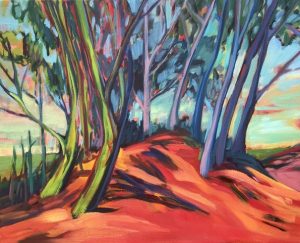
Traverse City artist Pam Spicer, 68, speaks through her work. “My voice is my [paint] brush,” she said. “That’s … how I interact with the world.” The world she paints is colored in an array of colors not necessarily found in the natural world. And every time she touches her brush to the canvas, she’s problem solving: questions about light, shape, what’s up front, what stays back. It’s all in a day’s work.
This interview was conducted in September 2025 by Sarah Bearup-Neal, Glen Arbor Arts Center gallery manager, and edted for clarity.
Pictured: Pam Spicer
Describe the medium in which you work. What is your work?
I paint with oil paint mostly, and occasionally with acrylic gouache with a palette of warms and cools.
Talk about that palette. It’s a distinctive characteristic of your painting. The colors are very saturated, and it’s an unusual family of colors
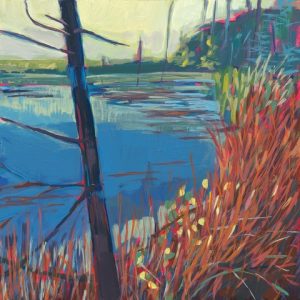
I was taught by my teacher, Nina Weiss, to lay out a palette of blue, yellow and red; using a cool red, a warm red, a warm blue, a cool blue, a warm yellow, a cool yellow, sometimes a little Prussian blue, and white. With that palette you can mix anything. You don’t have to go out and buy all the paints. I’ve taken color theory several times with Nina, and it teaches me the science behind it; the way to mix color by neutralizing the color with a complement; and the difference between bright and light. Bright can be in the foreground. Light is in the background. It helps with depth.
If anyone flips open the Blick catalog to the oil paint section, there are about 875 million different color choices one can purchase.
Don’t need them.
None of that is seductive to you?
No. Because I can make them.
What is it about being able to mix your own colors that’s appeals to you?
The fact I know how to get there; meaning, I can manipulate what I’m looking at by neutralizing or adding more saturated color, by adding white. I know how to work the machine behind the curtain.
What draws you to working in oil?
I love that it’s luscious. I can layer it. By layering color, I’ve learned how to create form and depth. So, when you put a cool blue down, then a little glaze of orange, it will shift it.
Talk about the formal training you received in visual art?
I studied art and design at Alma College. I received a Bachelor of Fine Arts degree in design [1979]. I knew entering Alma, I wanted to study art. I didn’t know what that would mean; but I wanted to combine art and business. I also studied for over 14 years with my teacher, Nina Weiss in Evanston, Illinois. She is a fabulous, serious landscape painter. She tells it like it is. I like that kind of direction. There’s no beating around the bush. She’s helping me.
How did your formal training affect your work as a creative practitioner?
Alma College is a small liberal arts school, so I was able to directly interact with fine artists. I was also able to study science and writing, music, and I was taught to problem solve and collaborate. Both have served me well. I love to collaborate with people. It opens a world of possibilities I might not have thought of. Problem solving is so important. It happens all the time, even on a painting. I remember Nina telling us, You’re problem solving all day if you’re working on a painting. Every time you touch your brush [to the canvas] you’re solving some sort of problem: Where does the light hit? How do you push that back? How do you bring that forward? It happens in everyday life when you’re talking with others. I’m fully supportive of liberal arts colleges. They teach you to think. They don’t teach you how to do a particular task or job.
[In the 1980s, Pam moved to Chicago, and was employed by Frankel + Company] — as an art director, “a sales promotion agency where I thrived. Full of problem solvers and creative people. A lot of time people think I was a graphic designer. I was not. It was part of what I did. Our main client was McDonald’s. As their National Sales Promotion Agency, we would develop in-store promotions, incorporating their partners, like Mattel and Disney.”How did your visual art training come into that?
The design [training] was huge.
Your creative professional life was not silo’d. It sounds like it was integrated in so many ways.
I felt like my fine arts roots helped me think more creatively.
Describe your studio/work space.
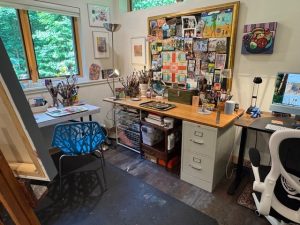
We built our house, so I was able to design [the space] I wanted. It’s a lower-level walk-out.
What themes/ideas are the focus of your work?
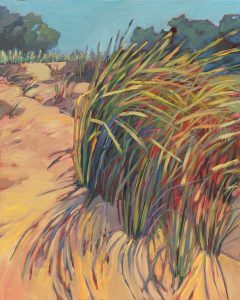
Nature. More specifically, images I take with my camera that capture light and shadow in the landscape. I always carry my camera, which is my phone. I take so many pictures, and then I study them, figuring out what I want to do with them.
Do you stick with landscape; or, do you have interests that move beyond the landscape [as a subject]?
I do all kinds of things: images from my travels, from Northern Michigan. I don’t find myself photographing people. I like form, light and shadow, darks and lights.
As a painter of the landscape, it’s getting harder and harder to find landscape where you’re not encountering people or artifacts of the dominant world. How does that challenge you?
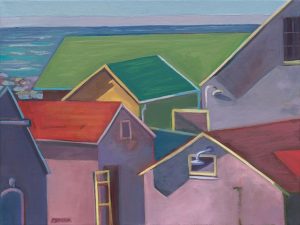
I manage to find [the landscapes she wants to paint]. I’m a morning person, so I’m often taking photos before people get on the scene. I love getting up early, inhaling nature.
Do you ever eliminate things from your landscape paintings, electrical wires for instance?
It’s another part of problem solving: That’s not working for me, take that out. You have creative license to do that.
What’s your favorite tool?
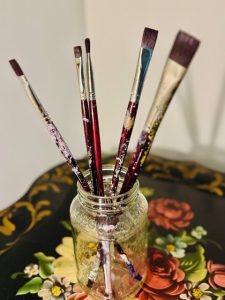
My Utrecht Tuscan Synthetic Brushes in bright. I have more than 30. They’re squared off brushes, and with that I can go in and make a line, or make a flat edge, or create the layers I need to. I find if I buy other types of brushes, I don’t use them. They sit there.
Do you use a sketchbook? Work journal? What tool do you use to make notes and record thoughts about your work?
I love the idea of using a sketchbook, and I own about 10 of them. Do I use it? Only briefly. I use it to create my compositions. I’ll draw the shape. Then I’ll work with four different approaches to how I could put that composition together. But my main tool is my camera. I zoom up, I zoom down, I refer to it. I also take pictures of my work at different stages, and make decisions based on that. My camera is my main, go-to tool.
When did you commit to working with serious intent?
I’ve been painting seriously since I started [studying] with Nina — about 18 years.
What were the circumstances?
It shook me up. I was constantly thinking of [painting]. I was always problem solving: Oh, I know what I can do with that [painting] when I get home. There was excitement around it, [the feeling] that this is what I need to do. My boys were becoming more independent, so I had the time to focus on what I wanted to do with my work
What role does social media play in your practice?
I am inspired by artists I see on social media. Sometimes I follow them. It helps me to think differently. In terms of me putting my art out there, it’s a constant push-pull. I tend to put it on Facebook or Instagram. I don’t know that Facebook is the right place for it, but it’s where the people who are interested in what I’m doing reside. I toe the line between look-at-me [self-promotion], and then I cut back and I get these comments from people [peers] asking me where I’ve been and why they haven’t seen any of my work recently. It’s a real struggle for me.
How has your level of comfort with talking about, promoting yourself and your work changed?
Working in sales helped me. The training helped me to recognize that it’s OK [to promote herself]. It doesn’t mean that I’m bragging, or a better painter than anybody; it just means I’m excited by things. Sometimes, when you put yourself out there, things come back.
What do you believe is the visual artist’s role in the world?
To create honest expressions; don’t try to paint [like someone else]. To collaborate. To share ideas. Do justice to others by being thoughtful and a curious observer. In high school I studied poetry, and my creative writing teacher taught me to really study the work to do the [writer] justice. Don’t just read the poem at face value. Look at the way they put the words together. Being curious about other peoples’ work really helps me.
How does living in Northern Michigan inform and influence your creative practice?
The fact that I have a dedicated place to paint in Northern Michigan is huge. The four season, and the light — I’m hugely affected by the light. Now, I’m already feeling fall. There’s a little tinge of cool in the morning, but I’m also feeling the light. The four seasons affect my mood, what I want to create. I can get outside and paint, and that’s very cool. I never did that much in Illinois [Pam and her husband, Steve, moved permanently to Northern Michigan in 2019]. It was busy. I wasn’t drawn to it. [Living] more with nature definitely plays with what I’m doing and thinking about.
Did you know anyone, when you were growing up, who had a serious creative practice?
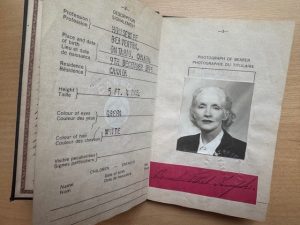
My Auntie Pam was amazing. She was a serious painter in Canada [Ontario]. She was the one who’d put beets on our plate — “just for color.” She had to have the plate looking pretty, and that’s affected me my whole life. I can’t just serve even a lunch that looks bland.
Auntie Pam took her work seriously, and she sold her work. She was influenced by the Group of Seven. She died when I was a freshman in college, so I was able to have some conversations about art with her. I have this picture of her, [taken after her husband had died]. She traveled to Banff, and rode the gondola. There’s a picture of her with her sketchbook, up on the gondola, with her scarf flying. She’d visit us every year, and create some sort of fun project that involved [for instance] going to Kresge’s and asking the jewelry department if they had any broken jewelry. We’d take it home, get old fabric and make the Three Wise Men with jewels on old bottles.
What was it about your Aunt Pam that made you think, That’s me. I can do that.
She just lived it. It was who she was. Even though my mom was a great painter, she poured herself into her four children. My great aunt didn’t have any children. I noticed, though, on her passport, under occupation it said “Housewife.” She never described herself as a painter although when I would talk with her, as a kid, she’d talk very seriously about her painting. Her whole house was her palette.
Who has had the greatest and most lasting influence on your work and practice?
My mom, Joan Wehmeyer. She always encouraged my creative energy, and she spoke of my art seriously. I remember she never made me feel like I’d better come up with Plan B. My dad would always say, Do what you love, and the money will come. I realized I loved being involved in the creative process. Both my parents were very encouraging.
Where or to whom do you go when you need honest feedback about your work?
I go to Nina Weiss, my art teacher. And I also go to my friends Diane and Claire. I worked with both of them in Chicago. They’re both painters. We always send examples of what we were working on, and ask, What do you think? They’re honest.
Talk about the role exhibiting plays your practice?
I welcome it. It puts me out there. It’s a challenge for me, and it’s important for me to be challenged. It’s a language I love to engage in. I try to challenge myself by applying to a variety of shows. It’s exciting. It gets my blood flowing.
How do you feed and nurture your creativity?
Travel, and sharing ideas with friends. When I travel, I like to get up early and see how things come to life. I like to talk to people and figure out what they’re excited about.
What drives your impulse to make?
It’s part of my DNA. That’s my voice, it’s how I interact with the world. My voice is my brush. It could be because I grew up around painters — I don’t know how to think of it differently.
Read more about Pam Spicer here.
Sarah Bearup-Neal develops and curates Glen Arbor Art Center exhibitions. She maintains a studio practice focused on fiber and collage.