Creativity Q+A with Kristina Schnepf
Kristina Schnepf, 56, just wanted to learn how to be a more skilled woodworker — not how to make a particular style of chair or table, but skills. Finding that kind of instruction to be nonexistent locally, what other option did she have but to found a school. The Green Door Folk School in Cedar, Michigan, is about honing skills, deep and long learning, and the beauty of practice. Class is in session.
This interview was conducted in September 2025 by Sarah Bearup-Neal, Glen Arbor Arts Center gallery manager, and edited for clarity.
What is your work?
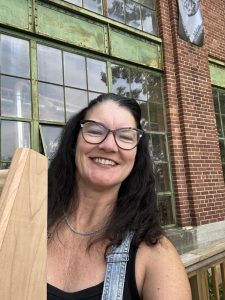
My work is founder and director of Green Door Folk School, and also owner of Peace, Love and Little Donuts in downtown Traverse City.
Talk about the ah-ha [!] moment in which you thought, I’m going to start a folk school in Northern Michigan. What prompted it?
I was actually looking for woodworking classes. As a woodworker myself, and self-taught, I was looking for instruction that would help me gain skills in ways that YouTube videos [could not convey]. I looked locally for options, and came up short, aside from a degree program at NMC. I reached out to cabinetmakers and trim makers to see if I could just volunteer in their shops, and didn’t hear back from anybody — it’s a little weird to reach out to somebody and say, Hey! I’ll do all your sanding if you will just explain what you do, how you do joinery and stuff. I was coming up short locally, so looked broadly and came up with folk schools in other parts of the country, and was really turned on by what I was seeing — not just from a woodworking perspective, but from a handcraft/nature [instruction perspective] for either fulfillment or sustainable living. I was really thrilled with the concept of the folk school. I had not known of folk schools previously, but as I was looking I found some woodworking and other classes I was interested in taking, so decided to do a tour of the Midwest, visiting a number of different folk schools — primarily in Wisconsin and Minnesota. After that week-and-a-half-long trip of visiting folk schools, [in January 2024] I was convinced that Northern Michigan needed one of these, and we were so well suited to having one. We have many artisans and crafters and naturalists who can make great instructors. We have a community that is interested and curious and wanting to learn. We’ve also got an audience of people who come to the area seeking ways to engage more fully with Northern Michigan. I felt a folk school was a really nice way to bring all of those things together.
What did you want to learn to further your woodworking skills?
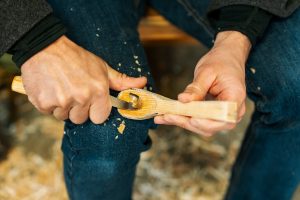
The kinds of things I wanted to learn were different methods of joinery, and how to do them well, whether it be with hand tools or power tools. I usually make furniture, and I wanted to expand that. I wanted to be able to do higher quality joinery, better wood finishing, things like wood species and what to use for different projects. Those were the things I was interested in. So many of the programs I was seeing were Make This Particular Chair. That’s great, and then you have one chair.
You weren’t interested in a project, but in learning how to use tools and materials.
Correct. What I found were a number of programs that enabled growing your skills. A lot of folk school classes are project based, and sometimes that’s the best way to learn certain skills.
What’s the history of organized folk schooling in Northern Michigan?
In Northern Michigan there are two folk schools in the UP [Upper Peninsula]. The Friends of the Porkies in the Porcupine Mountains is a folk school in that state park area. There’s also a folk school in Houghton that is called the Finnish American Folk School; it was part of Finlandia University when that university existed, but is now and independent folk school. There’s also a small folk school in Kingsley, Michigan, and they tend to do occasional classes. Folk schools tend to be different from one another. They take on the form and the nature of their community. One of the sayings [of the folk school movement] is: “Stick your finger in the ground and smell where you are.” That’s what I love about the folk school movement. It’s hyperlocal. It’s very much about who your community is, and what resources exist in your community. These define what the folk school offers. They’re really very different even though they have some similarities; the focus on [for instance] traditional skills. But North House Folk School in Grand Marais, Minnesota, works with only woods that can be found in that area, and is very northern-craft focused, so they make snowshoes and wooden boats.
What does Green Door School offer? And, how is it reflective of its locality?
 When we started [March 2025], I had done a ton of research locally. I’d talked to people in the art, nature and small farming communities, and got an understanding of what people were interested in — our classes in large part were focused on where I could find instructors at that point in time. But what we found is the community tells us what they’re interested in by showing up. Or not. What we’ve found is people are super interested in and most excited about classes that use our natural resources for some other purpose. Doing a natural dye class where we actually forage and harvest the materials for the dye — not just learning how to dye, but how do we use our land, our space, our resources responsibly to do something useful.
It also requires that people begin to understand who they live with, what the plant community is about.
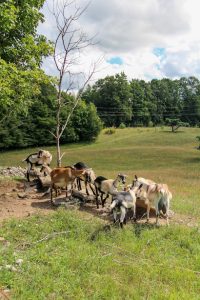
Yes. And the animal community. We just did a goat cheese making class. People wanted to learn how to make the goat cheese, but we were on a goat farm. We milked the goats. So we went from milking the goats to understanding milk purity, care and safety of milk from local animals, then using that to produce the freshest cheese ever. Spending time with the goats, getting to know the goats’ names, those kinds of things are what people get so excited about, and what enables them to connect with the real thing, the natural aspects of things.
I can’t help but think about the context for learning so many of us have experienced, which is public school. Because of the vast numbers of human beings that go through public schooling, things become standardized. So often, you scratch your head and say, What does this have to do with my life? Folk schooling is entirely different. It’s not standardized education. It’s hyperlocal. So, who are the students?
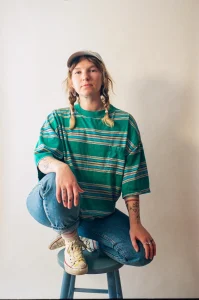
The students are the best. I’m so thrilled by the mix, and the interests, everything about these students. There’s young and old, male, female, straight, queer, local, statewide. We’ve had people from New York, Connecticut, California. This weekend we have a class that’s three-days long, and we have people coming from all over the country. It’s called Quilt Camp. The instructor [Cody Cook-Parrott] is local, but renown nationally, they have a following and people want to spend time with them. Because our [school’s] location in Cedar [Michigan] has a guest house and some Air B and Bs affiliated with it, students can actually stay on site and do Quilt Camp.
What was the vision around which you organized Green Door Folk School?
I based it on feedback from the community. I talked with upward of 100 people before I really set in stone the plan and the vision for what the school could be. I also kept saying, if the community doesn’t need this, I don’t need to do it. It wasn’t like I had to do this until I had to do it. The community was asking for it. There are lots of classes in our community; lots of different ways people can learn; so, I didn’t want to duplicate that, and [she asked herself] what was different about folk school classes than what you can get at other venues?
What I came up with, and what people felt like they wanted, was more depth. We tend to have longer classes, they’re rarely less than a day, and usually 1-3 days generally. We’d love to do longer, too. Slower learning. Very practiced — not being told what to do and getting a few minutes to practice it, but actually spending a day or two doing the thing. Enriched practices are important to us: foraging the materials you’ll weave with, or visiting the farm you’re going to use produce from to cook with. Those longer, slower, more enriched kinds of classes are what we’re focusing on. And that’s what we’re finding people are really interested in, too. It hard for people to give up an entire day or a couple days for something that’s self-fulfilling. But the feedback we get … There was a mom [who told her], I could not remember the last time I did one thing for an entire day. You think about that: We do 75,000 things in a single day, and she did this one thing all day. It’s so gratifying. And we’ve had other students say, The world doesn’t want us to know just how good this feels, to just sit here and carve a spoon. This is what it’s all about. And, then people making connections between nature and craft, and nature and being human, and recognizing the metaphor for their lives. We’re talking about more than just this stick you’re going to weave into a basket. It connects to something deeper, and much more human.
On your website I read this: “Folk schools provide an educational training ground for a more just, sustainable, and hand-made future.” Two things:
Thing One: We — and you alluded to this in your response — live in a time when the cult of machines rule. Concurrently, we struggling with justice and sustainability.
Thing Two: I’m interested in the conjunction between the handmade and those foundational principles of justice and sustainability. Why is this combination of principles and practices so potent, but yet it’s under fire? It’s like we all have to be machine operators.
It’s under fire because it’s potent. It’s the thing that could derail the system, that makes people afraid, makes the system afraid. We live in a modern world. We can’t escape having phones and computers and things that help us be current in our environment. But there is an absolute groundswell and desire to feel more connected to each other. We know that eating well, exercise, connecting in community, and being in nature are the things that make a healthy human.
How does the handwork fit into all that?
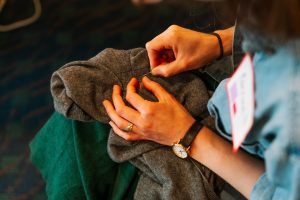
Because it connects you to direct materials that are natural, and slow; to intentional movements that don’t require technology. They may require a tool, but don’t require digital technology that has taken us away from being hand focused. It could be so many things. It could be working in your garden, and understanding it. It could be the same, slow movements of carving or weaving or spinning — the tactile feeling of having wool in your hand and turning it into something that could be useful and meaningful for life. That can’t be done or found in a lot of modern activity, and in most modern jobs.
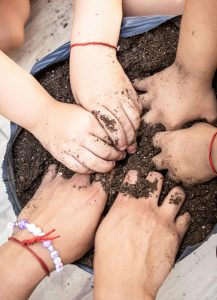
You’re talking about the difference between directly experiencing something, versus abstractly “experiencing” it. There’s something so fundamental. One of the easiest examples we can give is of people digging in their gardens. Getting dirt under their nails.
Making something exist that didn’t exist before: Those things can’t be replicated in a digital world. Or in a passive world where we’re being entertained by something else out there rather than something we do, and feel, and understand, and enjoy in our hearts
In 2019 you returned to Michigan — from where and from what?
I spent the majority of my life working in the very kinds of work I think caused me to recognize that I didn’t want to work in ideas or theories or digital space any longer; and wanted to be more tactile. I was a corporate executive in a couple different companies, and most recently had moved back from Ohio to Ann Arbor, but then COVID hit. We made some life changes and accelerated some things. We ended up here where we wanted to be longer term anyway. COVID modified certain plans for a lot of people, and that happened to me. During that time period, I was waiting to be led. I was too young to be retired. I was running our donut shop but I knew there was something else out there, and I would never have told you it was a folk school, but here we are.
In a recent newsletter, you wrote that there are 66 folk schools in the Folk Education Association of America and each one is different. And then you quoted Ludvig Schroder, who said, “ ‘Stick your finger down into the ground and smell where you are! This is where the needs of the people are found, which can be different in different times and places. Where this meets the abilities of the teacher, there lies the folk school’s calling.’ ” Was he a guy ahead of his time? Or, was that reflective of the thinking about teaching and learning of his time?
Probably a little of both. We can say ahead of his time, but maybe he was right in his time. It was a time when people were more connected: Who they were was so much about where they were. When the only things you could acquire were the wood or the soil, foods in your local landscape, that’s what you learned to work with, where your skills came from. I think [Schroder] was ahead of his time and how to educate, but probably well-connected to his environment. One of the really interesting things about N.F.S. Grundtvig [the ideologic progenitor of the folk school philosophy] — he started folk schools in Denmark in the late 1800s. The purpose was to bridge the educated elite with the local, rural farmers, and try to create [an educational system] that didn’t necessarily create intellectuals, but could move students off of their farms to do other things than their family’s farming activities. The original folk schools were more like trade schools. Those schools — teaching trades, creating more mobility — were one of the things attributed to Denmark becoming a democracy, which is super fascinating to me: Democracy requires an educated populace, people who are capable, people who understand who they and where they live and how they fit into that community. We’re moving so far away from that, so how do we start bringing that back to our people? Having people in community for days together is so powerful. There’s nothing that replicates that. You can’t watch, listen, podcast or news program your way through stuff.
The other piece of that is having a capable community where I know how to do a handful of things, and you know how to do a handful of things, and then all of a sudden, the capability is in our hands collectively, rather than in an Amazon warehouse somewhere. We are capable of doing these things — not at the volume of an Amazon warehouse, but at the speed and volume necessary for our individual lives. And, collectively, we can do all these things
It’s such an interesting component of folk schools, this Hi! I’m going away for the weekend to learn how to carve a spoon! Thing. There are so many other things that could come out of that. You can’t just explain it in a bumper sticker.
You need to experience it, and even people who go in anticipating a great experience are always surprised at how much more they got out of it. The slowing of their minds to think things through. The conversations with people they might never have had contact with. There’s no explaining it in the description of a class. We try, really hard, to give a good perspective, but there’s things you’re going to get that you can’t explain.
What was your experience growing up with creative work? Were there people in your life who had creative activities? Were there role models? Talk about that.
I did not grow up in a traditional, handcraft-type-of-family. My grandfather was a woodworker, and I believe I have some of him me; but he did not teach me. I have a cousin who learned from my grandfather and has taught me many things. It wasn’t our family’s lifestyle. We were a modern, ‘80s family. But I’ve always been curious, and open and willing to try new things, in dabbling in handcrafts. Until I started woodworking, I wouldn’t say I was an artist, or a crafter in any real sense. I think I represent someone who has yearned for the feeling of connection you get when you do this work.
How do you fill up your own creative well?
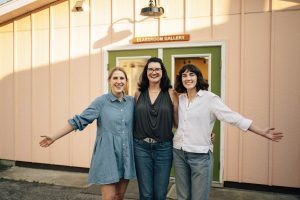
Well, now I have a folk school. Seriously. Every weekend Lauren, one of the women who works with me, and I sit there and say, This is our job. We get to do this. I fill my creative well with the amazing instructors we work with, the students who show up, the creativity they have. Maybe it’s the way I always have. I’m a learner by nature, and exposure to new things inspires me.
What is the green door symbolic of?
It is symbolic of a green door I painted on my family home when our daughters were young. We had a gray, saltbox house that was beautiful but nondescript, and I wanted our door to make more of a statement than it did. So, I painted it a lime-y, chartreuse-ish green color, and loved it — it was striking against the gray, just different and fun, and looked like joy to me. But our neighbors were, What’s with the door? They weren’t as pleased with the door as I was — to a point that I wondered why does everyone care. Who cares? I wrote a poem as a result of that titled Behind The Green Door, and what happens in a home that enables creativity, breeds joy, creates comfortable love. It was because of the door I painted, and the poem, that we decided we wanted the folk school to be a similar model of creativity, comfort, love, joy, and curiosity — all the things the green door represented in our home.
Read more about the Green Door Folk School here.
Sarah Bearup-Neal develops and curates Glen Arbor Art Center exhibitions. She maintains a studio practice focused on fiber and collage.