Creativity Q+A with Jessica Kovan
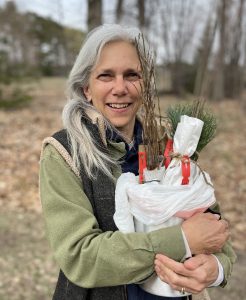 Jessica Kovan, 63, is a painter-writer [or writer-painter; she’s still figuring that out] living in Benzie County. Before this, she wore suits, panty hose and did important work on behalf of the natural world. Then came an epiphany in Detroit’s Metro Airport, and a life-redirecting gift from her Cousin Max.
This interview was conducted in January 2026 by Sarah Bearup-Neal, Glen Arbor Arts Center gallery manager, and edited for clarity.
Describe the medium in which you work. What is your work?
I consider myself a mixed-media artist, which, in my mind, means I can use anything I want, but I’m primarily a painter.
You call yourself a painter, but you don’t silo yourself. Your painting is one of the many tools you use to do a variety of things.
I agree with you 100 percent. When people ask what I do for a profession, and I say that I’m an artist, they want more information. I usually end up saying I work as a painter, but it doesn’t feel accurate to me. Normally, people are going to see my work hanging up on walls. I think that’s [why] people put me in that category. I’ve been thinking a lot recently: Am I artist who writes? Or, am I a writer who paints? It’s a long time before [one is] comfortable saying, I’m an artist. I’ve realized it has taken me even longer to be able to say, I’m a writer.
You’re talking about the text that appears in your compositions, as well as your writing in the conventional sense?
Yes.
I’m interested in your comment that people see your work hanging on a wall, and their context for understanding things hanging on the wall is “painting.”
“Artist” is a very broad term. How do I give a person a context to even keep the conversation going?
For people who don’t have any experience with people who do creative work, we’re not boxed in; our materials and ways of working overlap and tangle up. In your case, you use your ability to paint in all different ways. The subject of making one’s own materials is applicable to what you do, too. It might come as a shock to some that you don’t rush out to a big box art supply store to use in your Capital “A” Art.
When I’m painting my papers [used in mixed media], I’m using traditional acrylic paints, but I’m also using the [paint sediment] at the bottom of the water container. I’ll let the paint in my [soaking] brushes settle overnight, and then I pour out the water on top, and then I paint on tissue paper. I’m also painting on top of old canvases, painted by other people. It adds another element I really enjoy. It’s someone else’s creativity I’m working on top of. I have to decide how much of that other artist’s [work] I want showing through. Sometimes I want some of it to show through: I like that concept. Sometimes it just doesn’t work. The texture will show through.
What draws you to this kind of work? What speaks to you about working in mixed media?
It started with the simplicity of it. I stepped back into being a creative person when I was working in academia. It was an outlet. I started with pottery. I love pottery; there’s nothing like throwing a pot, the physicalness of it, and coming away tired. When I’m painting in watercolor, I don’t come away tired. I became a mother of young children, and you just can’t take them to the pottery studio, so I started painting for the ease of it. I took a mixed media workshop, and I was in heaven. Suddenly, I could put my physical body into the papers and just push without ruining it
I see your painting as part of the whole composition, but there’s lots of other stuff going on in them.
I’m trying to communicate a message, and then I think how do I want to communicate this? The sky’s the limit. But my tools often include paint. Right now, I’m working on a series I call Mama Love. What I want to communicate is that all species love and care for their offspring. I want to show [this series] altogether, but I don’t want it just to be paintings. I also want sculptures. I want the viewer immersed in it. I think people are touched by different means [of expression].
Describe your studio/workspace.
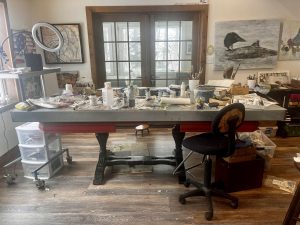
I’m extremely messy person, so I wanted my workspace in the back of the house instead of the front of the house so it wouldn’t take over. I could do that. I have an unheated garage studio, too. I have a hard time being inside so as soon as it’s nice out, I want to be outside.
Your work is very personal. How do personal subjects become the basis for your work?
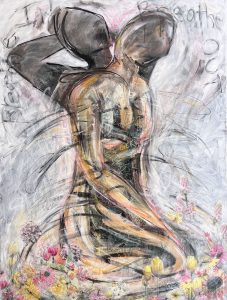
I don’t know how they wouldn’t be. Let’s talk about Screaming Inside [on exhibit in the GAAC’s INteriors show]. The painting itself, and my artist’s statement: People are really responding to them. I’m getting personal notes. I’ve also had people worried about me as a result of it. That painting came about because [the GAAC] decided to have a show called INteriors. It didn’t come about because I’d somehow decided I have to communicate what I’m feeling on canvas, and get this out. Some people have kindly said I should [burn the painting], and release the feelings into the atmosphere. But [she tells them] there’s an art center in the area that’s having a show about interiors, and what can I paint for it? People are going to paint the insides of their homes. I want to paint the inside of my body. I was peeling apples in the fall, and I suddenly remembered my daughter in high school giving her hair to Locks of Love. [After the hair cut] she was really quiet and I asked her how she felt. She said, I’m crying inside. I’m sitting there peeling apples and I thought, I’m screaming inside. I went to my computer and wrote the 100-word statement — before the painting [was created]. And then I thought, How do I show this? It was hard to figure out. It’s a universal feeling, and how do I show that? I just kept playing [with the composition]. I took it to a workshop that I was teaching about climate anxiety, and talked about it — what we don’t let the world see what we’re feeling on the inside. I invited [the students] to write all over the canvas, and then I was going to figure out how to hide [the writings]. That painting wasn’t cathartic. It was fully, 100 percent conceptual.
Why are you working in such a personal way?
It’s the spark that ignites my creativity. Even if I look out on a beautiful landscape, I’m still thinking, What am I feeling? How do I communicate what I’m feeling? I don’t know a different way. It’s just who I am.
Let’s talk about the vulnerability that accompanies work that is so personal. When you’re sharing interior thoughts publicly, what do you hold back, if anything? How much of yourself are you willing to reveal?
People will often say to me — especially about the writing in my Mixed Media Monday [blog] — I’m so impressed by how vulnerable you are. I’m not vulnerable; I’m telling you what I want you to know. There’s so much more there. In some ways, I’m a storyteller. We all have stories, and I think it’s helpful to share. I want my writings and opinions[to be] interesting. And so I try to figure out what am I trying to write, or say, or create that other people will feel.
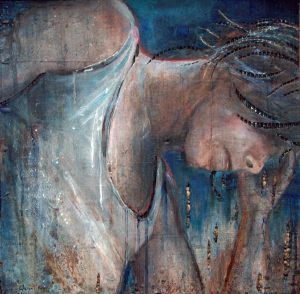
Years ago my family went through some hard times, and it broke us as a unit. We all fell apart. And I created a painting about it. This is what I love about being an artist: While I was falling apart, I thought that I needed to capture this. I grabbed my iPad, and started taking picture of me falling apart. It helped me stay grounded. Then I did a painting around that. That was for me. Never in my life did I think I’d sell that painting. It was hanging in a gallery and someone bought it, and I thought, Why would someone want a painting of me falling apart, in their home? I wanted to show the feeling of heaviness, of your tears being heavy, so I [glued] stones to the [painted] tears falling. I reached out [to the buyer], and asked. She had just gone through a divorce and said, You have captured, entirely, how I felt. It’s hanging over my mantel and I know I’m going to be OK. I made a deal with her, that if there’s a time she doesn’t need that painting, I would trade her another one for it. I saw her recently and mentioned this, and she said, No. I’ll always need this painting.
You could be misunderstood with the personal nature of your making, that you’re self-involved. It sounds like so many of the things that come out of mining your own experience have a way of reflecting for other people their own take on the same experience. Do you strive for universality? Or, is it you talking about you?
I think I assume universality, not strive for it. We are all living a shared experience. There are universal emotions. They might have a different context. Who doesn’t fall apart at some point?
What’s your favorite studio tool?
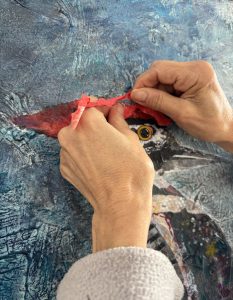
My fingers. I’m very hands-on. Even when I cut with scissors, I’m still pulling apart with my fingers. I’m feeling my canvas all the time. It’s how I pull apart papers. It’s how I glue. It’s often how I mix my paints [on the canvas] so there’s no brush line. It’s the physicalness, the being part of the process. I’m not sure why. It’s how I’m wired.
The first part of your professional life was as an adjunct professor of adult education at Michigan State University, Western Michigan University and Central Michigan University. What were the circumstances that were in place when you made the decision to switch gears, and commit to a serious visual art practice?
I was an adjunct at the three [universities]. I had been offered a [full-time] position at MSU, and accepted it. It was a dream, to get a job where you’d gotten your doctorate. Almost unheard of. I’d accepted it, and then my 28-year-old cousin Max died. I was flying to his funeral in Vermont, and was sitting in the Detroit airport, and I thought, Life’s too short. I want to be an artist. I called Jeff [her husband] from the airport, and said, I want to turn down that position and see if I can make it as a full-time artist. Will you still love me? And he responded, Do you know how happy you are when you’re painting? I called from the Detroit airport and turned down the position: I call it Max’s gift. I don’t think I would have been willing to take a leap out of academia into being a full-time artist without that. At that time [2007] I didn’t necessarily have the skills to be a full-time artist, but I had the desire. While working on my doctorate, I’d started taking community ed classes, in watercolor, to keep myself sane. That was my release while being a mom of small kids [3].
What role does social media play in your practice?
I have such a love-hate relationship with social media. Social media helps me communicate with other people. It helps people see what I’m doing. From my end, it keeps me present in people’s lives. I get inspired by other artists. I like community a lot, and as an artist you’re alone a lot: Social media provides community even if in some ways it’s false community — but it’s also with people I know. I also think there are so many evils involved with it now. When my mom was dying, I was her caregiver, and I was off social media. I was still painting, [but Jessica didn’t post any of her work then]. I didn’t sell a single painting in those six months. I didn’t care, but it was an interesting thing to realize: Social media keeps you present. That was such a clear example of how it does help you in your business of being a professional artist. I’m doing a funny thing now. I delete [her Instagram account] so that I’m not pulled in; and then reinstall it every time I want to post. I’m using it on an as-needed basis. I’m present [on social media], but on my own terms.
Your weekly newsletter falls under the social media umbrella. Talk about how Mixed Media Monday fits into your practice.
I started it as an email. I really don’t think of it as social media. I do share it through social media. I started it very specifically because I had so many close friends and family members who’d taken themselves off social media. I was actively posting [images of her paintings], and they’d ask about them. I realized that it wasn’t on them [to stay abreast of her work]; it was on me. I’m writing it for my good friends and family who’ve taken themselves off social media, and that’s how it started. It’s not about, Oh, here’s what I want to sell you, what workshops I want you to take. It’s more conceptual. It’s about how I’m seeing my week. I try to have it pertain to my practice, which is more like, How did this experience show up in my art?
What do you believe is the visual artist’s role in the world?
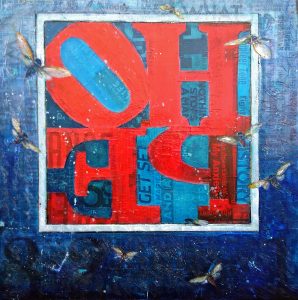
What’s fascinating is the arts can play so many roles, and every artist has to choose what role they want to play — whether it’s bringing beauty into peoples’ homes; whether it’s making things visible that we’re choosing not to see. The arts communicate in a way other media can’t. They touch people in a way other media can’t. So, what’s the role of the artist? There are so many roles, and there’s no right or wrong answer to that. I don’t want to create dark work, but I’m a thoughtful person and I think deeply. So, then — here’s that universal part — how do you bring that back so we can say we’re feeling this, and it’s OK to think about it, but it doesn’t have to bring you down. How do I communicate about climate change and what’s happening on our earth while showing my love for the earth, and that’s why I’m concerned.
How does living in Northern Michigan inform and influence your creative practice?
It keeps me sane — to be outside, all of nature. I’ve been painting birds now for as long as I’ve been up here. I’m working on a Pileated woodpecker [painting]. I went around my property the other day taking pictures of the holes in the trees that could have [Pileated woodpecker] babies in them. Living in Northern Michigan is good for my soul. [Jessica and her husband moved to Benzie County from Ingham County six years ago.]
Did you know anyone, when you were growing up, who had a serious creative practice?
I did. And, I wouldn’t have known what an impact she would have. Helen Edmunds was one of our neighbors, a full-time artist, good friends with my mom. She took me in as a daughter because she didn’t have a daughter. I worked for 10 years before I got my doctorate for the Kellogg Foundation wearing suits, nylons, the appropriate pin on my lapel, and the only way I could save face leaving the Foundation — it was a dream job; people try to retire to be a program director and I started out that way — I left to work on my doctorate. I saw Helen, and she looked at me and said, I never want to see you in a suit again. I can’t explain how powerful that sentence was. When you have a job like that, you feel cool. You have power. I was working to fund clean water projects in communities. It aligned with who I was — except for the suit. She was so right. I never want to wear a suit again. She was a full-time artist, and that was the life I wanted. It’s taken me a while to get there.
Who has had the greatest and most lasting influence on your work and practice?
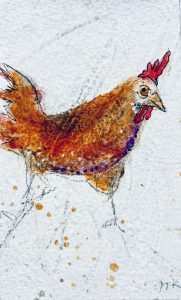
When I was working on my doctorate, I think my mom still felt guilty about saying no to [Jessica attending] art school. Then she saw [artmaking had come] back in my life and the joy it brought me. She gave me a gift certificate [to study with] Mark Mehaffey. I hadn’t seen him in 20 years [Mark was one of Jessica’s art teachers in high school; he now resides in Leelanau County]. It was a three-day workshop in [Okemos]. I walked in, and he said, You’re gray; and I said, You’re bald; and then we were back on perfect terms. Mark looked at me at the time — he hadn’t seen me since I was 18 — he said, I knew you were an artist. I always knew you were an artist. Welcome back. He believed in me.
I think Mark’s remarks are so interesting. He was saying that this — your desire to practice art — was self-evident. This is who you are, and gives you permission to embrace it. Is that what you needed?
No. When you choose an academic life, which I miss, you’re chasing your head. There’s something you’re proving about your head. Getting your doctorate — you’re proving that you can think. When you chose art, you’re chasing your heart. In some ways, Mark and Helen were both saying it’s OK to chase your heart. I grew up always feeling I needed to prove my ability to think. I love thinking, but now, I think I combine them both. When I’m at odds about what to paint, I paint hearts. The other is I use the Hebrew word hineni: Here I am. We’re here, and who are we going to be? It’s in a number of my paintings..
How do you fuel and nurture your creativity?
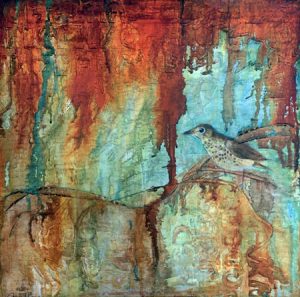
I would say it’s how do I fuel and nurture my life? Be outside. The biggest piece is to keep painting. In many ways, it’s entering shows, which is different than having your paintings hang in a gallery. The GAAC’s shows are so helpful to me, regardless of whether I get in or not. To have a theme to work with — that fuels my creativity. And working in a series. That really helps me a lot. It keeps my brain going. My brain has to be engaged in my art. I don’t want my work to be hitting people over the head, so you try to surprise people. When I’m working on a series, like Mama Love [about Northern Michigan birds and their babies], people will walk [into the gallery] and say, Oh, I’m looking at a show about birds and their babies. Then they’ll read my [artist’s statements] about them, and see there’s a much bigger message here. But a person could take home one of these paintings, and have a bird hanging on their wall, and just enjoy it for what it is.
Why is exhibiting important to you?
I like sharing. When I was 19, I was backpacking and standing in the middle of a birch forest on the edge of Lake Superior. I promised those trees I would always protect them. I went on to work in environmental fields, and then I became an artist. I asked myself, What am I doing? What am I doing to honor that promise I made in my early 20s? And that’s why I want to keep exhibiting. I want to keep people thinking [and asking] what their role is. I don’t know if I’m doing that. But I know that I’m trying.
What drives your impulse to make?
It’s a tool to be who I am. It helps me stay sane. I do know how to be other ways, but this is the most enjoyable way to be who I am. It’s a good life. I feel very lucky to be an artist.
Read more about Jessica Kovan here.
Sarah Bearup-Neal develops and curates Glen Arbor Art Center exhibitions. She maintains a studio practice focused on fiber and collage.