Creativity Q+A with Glenn Wolff
Glenn Wolff is an “almost” Traverse City native [“My parents moved up here when I was 22 months old from Detroit,” he said]. He’s a busy 72-year-old. Glenn works across many media and disciplines, exhibits here and abroad, collaborates with other visual and performing artists, and makes music with his band in his spare time. Glenn’s commitment to a serious life of art goes back to the last century when in “first grade … my teacher hung my map of Michigan on the door the classroom.”
This interview was conducted in February 2026 by Sarah Bearup-Neal, Glen Arbor Arts Center gallery manager, and edited for clarity.
You are best known as a visual artist. What is the work you do in the visual arts?
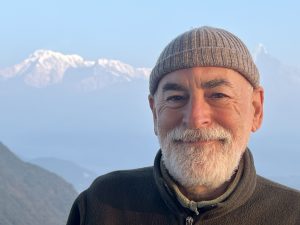
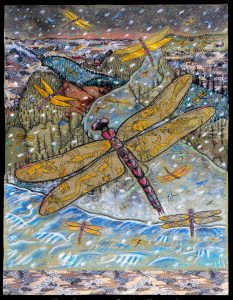
I operate as a visual artist on a couple different platforms. I work as a book illustrator, and started my career as an illustrator in New York. I also work as a fine artist, and exhibit in galleries, sell through my website. I collaborate, often, with environmental organizations. I work as a muralist in schools and public spaces in the area.
A lot of your work crosses over into mixed media.
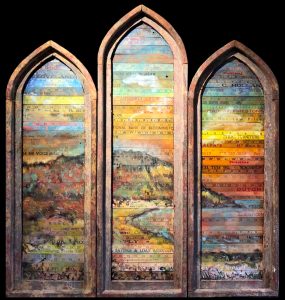
Yes. My fine art work does. I’ve spent so much time doing work for publications where it has to be very meticulous pen-and-ink, watercolor [illustration] that it’s a lot of fun to explore materials, and not have to worry about how it’s scanned. There’s collage in a lot of the work, but [the work] might also have found objects or an array of materials — like rusty metal, wood, or yard sticks or tar paper.
Did you receive any formal training in visual art?
I went to Northwestern Michigan College for two years and got an Associate of Arts degree [focusing on] drawing, printmaking, 2D design. I went from there [Traverse City, Michigan] in 1973 to Minneapolis College of Art and Design. I got a BFA [1975] in what they called “inter media.” It was a mixed-media program; it was the ‘70s, and we did a lot of different things. I started doing printmaking and drawing, and the traditional stuff, but got involved in some performance art with artists from the area. Also, started performing in bands. I think it was required in the 70s, if you were in art school, you had to be in a band.
How do you think your formal training affected the way you practice art?
There were a couple of amazing instructors that really focused on ideas, rather than the products or medium. They made us think a lot. One of those was the artist who’s best known for his neon work, Cork Marcheschi who lives in San Francisco now. Another sculptor, Siah Armajani, who was recognized all over the world, and was originally from Iran. They were big influences in how we thought about art then.
You said on your website: “When I’m not slinging ink or paint I make music, on bass with this great band …” How does making music figure into the ecosystem of your practice?
It’s another way to think about artwork — artwork that involves sound. It’s a great way to interact with other creatives. I can be in my studio for days all by myself and be pretty happy, but playing music gets me out into the world, and collaborating with incredible musicians — and seeing how those performances are received by the public.
What’s the name of “this great band”?
It was formerly known as Jazz North. It is now know as The Mighty Tundra Tones.
I’m wondering if there’s any cross-pollination between music and image/mark making?
Yes. The best example of that for me relates to a recent collaboration with a visual artist. The [Benzie County] mixed media sculptor-painter Dewey Blocksma just had a show at the Dennos Museum Center. He often uses found objects, musical instruments in his work. Someone gave him an upright bass, and he made a figurative sculpture out of that he called Bass Man. He reinvented the base, restrung the strings and put them in different places. He added other objects —a rod and reel, a rotary dial phone, some clickers, all sorts of interesting things — and he asked me, not as a visual artist but a musician, to make a piece of music using that sculpture. I went to his studio with the percussionist from [The Mighty Tundra Tones], Dave Goodwin, and we spent an hour-and-a-half recording sounds from the Bass Man. I collaged them together into a percussion track, and on top of that, started adding things with my own upright bass. Then I invited my friend Janice Keegan, the jazz vocalist, to add vocals to it in an improvisational way. And then, I invited The Tundra Tones guitarist, Angelo Meli, to add a guitar part. We basically made three or four different pieces of music from our original collection of sounds.
Describe your studio/work space.
Right now, my studios are in the house where I live. I’ve got a small room where I do drawing, painting, illustration work, print and mark making. Then I have a room in the lower level of my house that used to be a closet, but which now has an etching press in it. That’s where I do a lot of my printmaking. A year-and-a-half ago, I bought a motorized combination press doe lithography, relief, and intaglio. I’ve yet to use that so it’s in my garage. They’re all kind of small spaces, but mashed up, they allow me to function.
Talk about the themes/ideas that are the focus of your work?
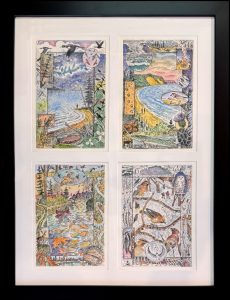
With my illustration work — book and publication work — a lot of times, it [the theme] has been the natural world. I’ve illustrated [ 10 ] books with my friend Jerry Dennis so those cover the gamut from fishing to general exploring the natural world and wild life. My fine art is more about the wonder of the natural world, the estrangement of how we are divided from it, or trying to reconnect with it.
What prompts the beginning of a new project or composition?
It could be a number of things. It could be a walk in the woods. Hearing a piece of music. Seeing something that someone else has done is very inspiring. Lately, the biggest thing I’m trying to deal with is trying to make art in the crazy world we live in, and make it relevant. I’m trying to not feel an enormous amount of despair every time I look at the news; and trying to think if I make something, how can that help?
I’ve spoken with people who find world events almost paralyze them, and aren’t able to do their creative work. It sounds like doing creative work helps you address the things you find chaotic in the world beyond your home.
It does, when I actually do it; but I do have the feeling of paralysis sometimes. Of being overwhelmed. So, I have to get up to my drawing table and sit down, and sometimes that’s all it takes, just being in that space, and not necessarily making a mark or another that goes anywhere. It’s just turning those gears again.
To what degree do you feel anxiety about retribution by someone or something that doesn’t agree with your world view?
That’s a good question. I feel varying levels of high anxiety — not so much about me, but more about friends and family. I have friends and family who identify as trans and LGBTQ, and I love them dearly. I feel anxiety about those close to me. I only recently, in the last week or two, have done an illustration that’s markedly political. It just went out into the world; I don’t think I’ll describe it, but it made me wonder what kind of reaction would that get? It started as something personal, from that desire, feeling that desire to make something relevant.
It’s inconceivable to me that people working in the arts have now become part of the group that needs to fear for its safety.
I met my wife [the late Carole Simon] on that corner [in Minneapolis] where Alex Pretti was murdered. That was our art school neighborhood. It’s a remote connection, but in a way it’s very real. My wife worked at the Black Forest Inn, which was a hangout for art students and teachers, and a block from there is where that altercation took place. I’m not in danger from that. It’s another perspective to add to that tapestry.
What’s your favorite studio tool?
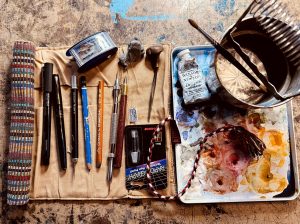
I suppose my pen. Sometimes it’s an engraving needle. A linocut tool. When I was a hardcore illustrator in the 80s, a “pen” was a Rapidograph, a mechanical drawing pen. Now they use Micron pens more. I still like that Rapidograph pen, although they were a pain in the a – – to clean. I still have a couple those, and keep experimenting with different pens.
Do you use a sketchbook? Work journal? Something to make notes and record thoughts about your work?
I’m not good at it, and I probably have a half-a-dozen ones that I grab any given time. It’s kind of hard, sometimes, to find where I’ve put ideas, but since I retired from teaching [in 2025], my partner and I have been traveling, so I take sketch books on those trips and do drawings on site — whether it be Mumbai, Malawi, or Kathmandu, places where I’ve gone recently.
So, the sketchbooks allow you to continue your creative work as you travel — as opposed to carrying another trunk full of equipment.
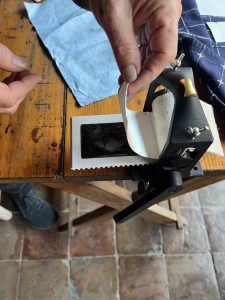
I’ve carried many trunks. When I went to Nepal last January [2025], I took a small 3D-printed, etching press, and did some drypoint engravings, and printed them over there. It was a lot of fun. [The press] was invented by a group called the Open Press Project. They’re 3D-printed etching presses that come in pieces you can buy. They’ve also open sourced their plans so that anyone with a 3D printer can download the plans and make one. I took [his printer] in parts [to Nepal] that I stashed in my luggage.
Why is making by-hand important to you?
It’s something I started as a kid. My parents were both very creative. My mother was an artist. She had an art gallery [Mrs. Wolff’s Underground Gallery, Traverse City, Michigan] when I was a kid, so there was always paint and printmaking, metal being pounded in our house. And both parents were musicians as well. They were both in big bands during World War II; that’s how they met. So, making [by hand] was a given.
Why do you think working with our hands remains valuable and vital in modern life?
It connects us to the world, to hold metal or paper or fabric. You and I and everybody our age has a fear of the disconnect a lot of younger generations are feeling just being attached to phones and digital media.
Let’s use that to segue into talking about your time spent teaching at Northwestern Michigan College.
I was there 11 years. I started as an adjunct. Maybe halfway through, a position opened up. I applied for it, and got it. Then for a very short time [2-2.5 years], I was the head of the art area there.
You were dealing with a lot of young adults who probably never knew a world before computers and devices. Talk about some of things you came up against coming from your background, which was about directly working with materials, and the abstract experience most of these students grew up with.
I think right about the time I went full-time, COVID [was present]. The first, biggest challenge was learning how to teach drawing or painting via ZOOM. The students, sometimes I could see them; sometimes I couldn’t. When we were back in class, in person, one of the-most frustrating things was to set up a still life, and finding students who were not looking at the still life, but at a picture they’d taken of the still life on their phone. Those were the challenging parts. The really inspiring things were the students who really embraced the notion of how water and pigment work on paper; oil and linseed oil work on canvas; how you actually etch a plate in ferric chloride. The majority of students liked that gateway back into the real world.
When did you commit to working with serious intent?
It might have been first grade when my teacher hung my map of Michigan on the door the classroom. I never really felt that I wanted to do anything else but be an artist.
Were you the kid in the class that could draw the horse, or the fighter jet; and kids would come to you and say, Draw this!
Yes. Or, I’d see those ads in the back of comics that asked, Can you draw this horse? I devoted a whole piece to that once, to that experience. I sent in the drawing, and my dad had to deal with the process of not buying the program [Famous Artists School].
NOTE: Watch a promotional video about the Famous Artists School.
What role does social media play in your practice?
It plays a role. It’s frustrating, but over the last few months I’ve been working a lot [on wood engraving and print making] for an upcoming project, and I try to do weekly posts to market the prints, where I’m showing. I also feel that in the last few months that I don’t know what’s real anymore on Facebook. There are people saying, If you like this, like us, and it turns out they’re AI-created people.
Not being able to trust one’s social media sources sets up a bunch of different hurdles. You’re finding you’re suspicious of things you might want to click on, but, conversely, I’m wondering if it has anything to do with how people regard what they see that you post?
Most of the people who follow me already know me. I don’t have that much of a national or international audience.
I think you hit the nail on the head: People know you. They have direct experience of you.
That’s a key. That’s all the more reason to keep performing, keep getting out there in the real world and doing exhibitions.
What do you believe is the visual artist’s role in the world?
The first one is to give us hope to keep moving forward. I don’t know that we can be so presumptuous that we can say we want to heal the world. Our job is to give people hope to keep on going.
How do you do that in your own work?
I try to create beauty as much as I can. Create interesting juxtapositions that I think will spark some new idea or relationship.
How does living in Northern Michigan inform and influence your creative practice?
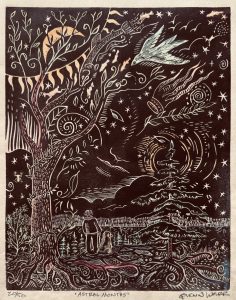
It’s so nice to be here, to be able to walk out the backdoor and be in the woods. In 15 minutes I can be next to Lake Michigan. Having said that, I loved when I lived in New York City [1978-1987]. Everybody I knew, when I said I was going to move there, said I was going to get swallowed up, and eaten alive. I loved it the minute I got there. And the nice thing about it: In New York City, you weren’t a weirdo for being an artist. You weren’t an outsider. So, I started getting work there. Part of the thing is going there and coming back, and it makes you appreciate the local landscape here even more. I went there after graduating from the Minneapolis College of Art and Design. I floundered around in Minneapolis for a while, and then my good friend [Traverse City classical and jazz guitarist] John Wunsch worked for a small off, off-Broadway theater company. They hired me to design posters and some set design, so that was an excuse [to relocate]. It was ridiculously low pay. I moved to the East Village, and that theater company folded immediately, so I became a foot messenger. I had a bit of a portfolio from art school and Minneapolis, so I started taking that around. I had one connection at the New York Times, so I was able to get my portfolio seen there, and ever so slowly began working as an illustrator. I became, mainly, the fish illustrator at the New York Times, for a column called Outdoors, written by a renowned author, Nelson Bryant. I was from Michigan, so they just assumed I knew about that, but I had not been a fisherman in Michigan. When I was there [in NYC], I was doing a lot of [illustrations about the natural world]. I worked for the Central Park Conservancy, the Bronx Zoo, Sports Afield magazine, Country Living. I was in the middle of this city, but I was doing all this nature-y stuff. Once I’m back here, often I’ll find myself doing a cityscape.
What made you leave New York City and come back to Traverse City?
Children. My wife and I had our first child, and we lived in a fairly-edgy neighborhood. When it was getting close to [enrolling the child in school], we realized we couldn’t afford fancy private schools. It [the neighborhood] was a little tough, and seemed like it was getting more challenging. We were either going to go back to Traverse City, where I was from, or Minneapolis, where my wife was from. Traverse City won the toss. Luckily, some of my clients, mainly the New York Times, continued to give me assignments. Once my work kept appearing in the New York Times, people would keep tracking me down — not knowing where I was located.
Who has the greatest and most lasting impact on your work and practice?
It had to be my parents, their high tolerance and encouragement, and it was never really questioned that I would want to be an artist or go to art school, or make that my path. They were both artists and musicians, so that’s probably it. My friends in art school in Minneapolis.
Where, or to whom, do you go when you want honest feedback about your work?
That’s mainly my children right now, Sarah and Simon. They know me so well now, they can cut to the chase really quickly.
What role does exhibiting play in your practice?
Teaching was demanding work, so I exhibited less during those years. I’m embracing the opportunities [now] to show my work, to get it out there. There’s so much more a person can see walking up to a painting in real life, as opposed to looking at a JPEG.
So, it’s a matter of wanting people to see the work your making.
And, I’m engaged in commerce, too. I want to sell the work, and survive as an artist.
How do you feed and nurture your creativity?
I think by looking at other creatives’, other artists’ work I admire. That can be on a local or a worldwide level. Raising a family and teaching full-time inhibited travel. I was not doing that for a long time, but I’m in a position where I can do that, and with a partner who embraces that. I’ve been getting a lot of inspiration from different places. And, commissions that take me places.
Do you want to give a for-instance?
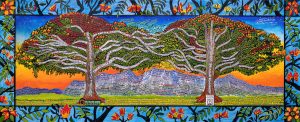
I was hired by the Blantyre Malaria Project, program from Michigan State University, to create a mural-sized painting to commemorate the 40 years of their project. It was started by a good friend, Dr. Terrie Taylor, who lives part-time in Traverse City, teaches at Michigan State, and has spent most of her adult life in Blantyre, Malawi studying cerebral malaria in children. So, I had to make a piece of art about that. That involved a nice commission, and creating the work that was displayed in the hospital where they do their research.
What drives your impulse to make?
I think I just have to do it. I hate being bored, but in saying that: I never get bored. I’m always needing to do something: sketching, painting, thumping on my bass.
What were some of the challenges teaching presented to practicing your own work?
It started as a challenge, but became a plus: learning how to articulate things that I’ve always done intuitively. How to synthesize that into talking points or a process. How to convey that failing is OK. Totally screwing up is part of the process, which I jokingly called in a lecture “The Suck Zone.” You start something on a beautiful canvas that’s white and pristine, and all of a sudden you’re at the bottom of well and you can’t get out, and it’s the worst thing you’ve ever made.
Based on your experience of having visited The Suck Zone, what comes out of that?
It’s learning — what works, what doesn’t work. It’s learning how to push on through, to continue to try again. There’s an enormous — with me at least, and a lot of artists I know — experimentation and failure rate.
What you’re talking about is the not-so-glamorous part of making art. It’s not all lightning bolts from God — the being in the trenches part of being committed to doing creative work; getting your nails dirty, and things not always working out as you imagine them.
One thing that helped [his students] get out of that zone was the tactile feel of making a mess. Kids still like to do that. There were also the students who, right from get-go, just knew they weren’t any good. When I could show them that they did something that really worked, it was great to see that light bulb turn on: Oh, maybe I’m not a permanent member of The Suck Zone. There was one student — we were working on watercolor washes, and she had a moment where she looked at me and said, Oh, this shit just got real.
Was she indicating that she’d had a breakthrough?
Yeah. It was just a simple way a little bit of watercolor pigment reacted with the water that was on her paper.
Read more about Glenn Wolff here.
Sarah Bearup-Neal develops and curates Glen Arbor Art Center exhibitions. She maintains a studio practice focused on fiber and collage.