Creativity Q+A with Elijah Nykamp
Elijah Nykamp, 30, is in the joy-sparking business. His eponymously-named business, Nykamping, is one part store front business, and one part working studio where he turns reclaimed, previously-owned, and well-loved textiles into comfy, happy-making garments. In Suttons Bay, Michigan? they ask him. But of course, he says.
This interview was conducted in September 2025 by Sarah Bearup-Neal, Glen Arbor Arts Center gallery manager, and edited for clarity.
Pictured: Elijah Nykamp. Photo/Lindsey Makuwatsine
What is your work?
People are sometimes [confused about his work]: Oh! This is Elijah. He … Well, tell them what you do. Do I say you’re an artist? That you make clothes?
Does it need to be one or the other? An artist or a sew-er?
No. They’re interconnected. It depends upon the perspective of people who enter this space [his studio-cum-storefront, Nykamping]. Some people say it feels like a gallery, and while that’s encouraging, it’s not. It has a retail element. It has a studio element. Other people treat it as a buy-off-the-rack retail space.
What draws you to the work you do?
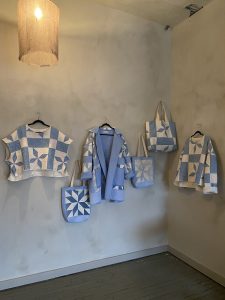
I really like restoration. I really like transformation. Using old textiles that have already had an entire life is my dream. I’m not looking to source brand new textiles. [The concept that drives his work is taking] what was loved and turning it into something that can be loved in a different way. In my custom work with people’s heirloom quilts, I talk about “utilization” — this is a chance to utilize your heirloom in a brand new way, especially if you’re not utilizing in its current form, e.g. as a quilt. [He asks how his clients] are going to interact with this thing you already have; but weren’t interacting with; but you really want to. It might be more exciting if the old textile is in a new form.
You have a philosophy behind Nykamping: Using reclaimed, previously-owned garments as your foundation for creating new work. What are some of the other philosophic underpinnings of Nykamping?
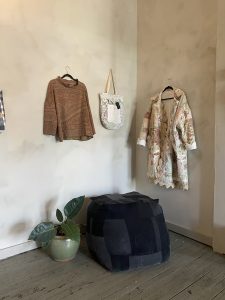
The foundational pillar of this business is local focus, both on the sourcing and collaboration. Collaborating with other local artists has been a foundational element from Day 1. I’ve collaborated with Mae Stier who’s a writer, photographer and poet. I’ve collaborated with Dana Falconberry who’s an embroiderist and painter; she embroidered a series of wildflowers native to Michigan on a small collection [of garments]; I’ve collaborated with Isa Scott, who uses botanical dyes made from marigolds, cosmos, and madder root that she grows in her farm in Northport. All the materials I source come from Facebook Marketplace, local neighbors, and thrift shops, consignments shops in Leelanau County and Traverse City. I take textile waste from our community and keep it out the landfill by turning it into something that is [for sale] in our local economy. Zero waste. I’m using every single scrap, including strips [of fabric] that are less than two inches in width; they become fill in a pouf I’ve been adding to almost six years now. The pattern pieces I cut out are [also connected] to this philosophy. I don’t just cut [new garment pieces] our of the middle of the quilt. It takes a lot of time to place pattern pieces so they use the entirety of the textile.
You wrote in a 2024 essay in The Boardman Review that “[W]earing clothes that ‘spark joy’ is a newer concept for me. Through a childhood in Holland [Michigan] and college at Hope [College], I never utilized clothes as anything other than function.” What caused you to shift your thinking about clothing as something other than functional?
That shift coincided with a personal shift of self, of embracing and celebrating who I am in so many ways. It was reflected in style, and [letting] fashion reflect who I am. I want people to be able to look at me in public and think, He’s doing something different. He looks comfortable and confident [whether you like my style or not].
Why should clothing “spark joy”?
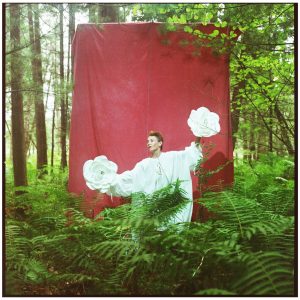
It adds value to my life every day — in so many ways other than the pivotal moment in the morning when you’re deciding what to put on your body. Having fun with what I adorn my body with allows me to prepare how people see me, how I see myself, how I love linen, how I love silk, how I love things made locally. Whether somebody sees that at first glance or not, it provides a conversational opportunity. I’m excited about what that can lead me to. It goes beyond function. Anything with a local connection, any garment [that is a collaboration of multiple people] sparks joy, even if the customer doesn’t know the people involved. It sparks joy for me to think of the work [the friends with whom he collaborates] put into their craft, it becomes a story. That’s unique to most of the clothes we wear; we don’t know what goes on behind the scenes with most of the clothes we wear; but for this, we do, and you’re buying into the story as well.
Talk about the background you brought to your work as a designer and a sewist.
I don’t have any formal education in designing and sewing. My mom taught me how to sew when I was 8; some of my first, very frustrating moments with a sewing machine started very young. I put that [experience] on the back burner. As an 8-year-old, the sewing machine is more of an enemy than a tool. I didn’t get back to a sewing machine until COVID [2020], and then it took off. I began to understand how a sewing machine works, how garment construction works. I was able to take some of the things I’d learn [as a child], and was able to put them into practice. I was able to make some garments I’d wanted; that’s how a “tent for your body” started [a Nykamping catch phrase and principle], an oversized silhouette that drapes, hangs off your shoulders, and doesn’t hug anywhere else. Nykamping pieces were born when I realized I had so much time [during COVID], and wanted to get back into sewing. [At the start of his business he watched] YouTube and Pinterest videos like crazy. My formal education is in early elementary education. Even my window displays remind me of when I was a kindergarten teacher. I want to make [his studio] exciting for people to walk into — that’s what a teacher wants in their classroom: a space that people enjoy being in. That’s the mentality I brought to this studio/retail space.
Since you don’t come from a background of design and design sewing, how did that liberate you in terms of what you felt you could do? You didn’t come with any preconceived notions about what’s supposed to work, and what doesn’t.
People have asked me if I felt like it was easier to do what I wanted because I didn’t have the education and the foundation of garment construction. I definitely think that was [freeing] in some ways — you can throw together what you want. At the same time, I struggled with some of the basics in the beginning. There is a benefit to knowing pattern making, and having an education in garment [construction]. YouTube was really helpful. And I have a vintage camp/chore coat [pattern] that I’ve worked and reworked countless times. Now that I do have a better understanding of garment construction, some of the limitations fall away.
Your studio space is also your storefront, and it’s in Suttons Bay, Michigan.
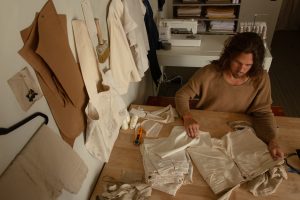
Yes. It’s about 600 square feet.
Does that feel large? Small? Just right?
It’s very Goldilocks. It feels like something that’s just perfect for the state I’m at with the business — just got through Summer #3. There are moments when it feels like there are too many people in the retail space. I only have three racks of clothing, and two windows that [customers] can interact with, and some things on the wall. I’ve realized that the benefit of having a retail-studio combination is that I’m a big part of the experience. This space is unique. It’s a weird side street, with a side entrance. Nykamping doesn’t have a door to the outside. You get to it through a hallway that goes to the outside. I share [the building] with a Zen Shiatsu massage [business], and a florist. We have a fun, little studio community back here, but it makes for a particular shopping experience.
When people come in, they can see you at work. What have you gleaned about how interested visitors are that you’re actually the person making the clothes right there?

It’s everything. That’s the driving force: Your purchase goes directly to the person you’re interacting with. I don’t know what the space would be if it were just retail, and I was making things somewhere else and bringing them in. Seeing sewing machines, having me working directly in front of [customers] is why I’ve been successful from the get-go. I was able to create an emotional connection with the people who walked in the front door. I didn’t need to build a brand and have backing because [customers] can see it right here. That being said, it makes my days long. I’m constantly interrupted.
We live in a time where most people don’t know where anything comes from or who makes it, or how it is made. People have limited experience with handwork. They must think you’re a genius because you can sew clothing.
There are a lot of people who are confused. I get this question a lot: It’s amazing what you doing; but why are you here? This is such an incredible space. This is such incredible work. Why aren’t you doing this in Los Angeles? In New York City? Their experience with handmade is limited to visual art. This area is so full of artists, and that makes sense to people; but for some reason clothing/garment construction belongs in the fashion districts. They want to know why I’ve chosen Suttons Bay. Well, I was already living here, and I loved it. I wouldn’t want to be anywhere else.
It’s not a part of our normal lives to interact with people [whose work is to] construct something. I love galleries, painters’ studios where you can watch painters paint. People are enamored of watching art and creativity in motion, in real time. We love the process; but we don’t want to wait for [the product]. I’m very process oriented. I love taking the time it takes to create [his clothing]. It takes me 8-to-15 hours to complete a big jacket.
What’s your favorite work tool?
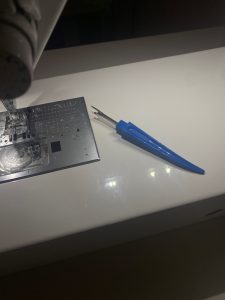
While I’m frustrated when I have to use it, [his favorite tool is] a seam ripper — that does the job when you need to do it. It’s super helpful. Mistakes happen all the time. Sometimes when I’m tired, weird things happen. The seam ripper is my favorite tool because it lets me know I can make a mistake, and lets me fix it.
Do you use a sketchbook?
I don’t. Most of the time, with sewing, changes can’t happen after you’ve cut the pattern pieces out. Any design exploration needs to be prepared before the garment fabric has been cut into. Sometimes I’ll just stare at the fabric. I’m good at visualizing. Sketching wouldn’t necessarily help me much. A lot of it is just designing in the moment.
What’s the role of handwork in what you do?
I don’t do much with [hand sewing]. That’s usually limited to the yo-yo quilt tops and tunics. Using a sewing machine requires a lot of hand work and coordination, between the machine and your hands pushing material through. You’re basically maneuvering and manipulating the fabric to do what you want. It can’t happen without your hands. It’s not a self-propelling system. I like that.
What kind of sewing machine are you working with?
I just got a brand, new machine through a local grant — I applied for a grant through 20Fathoms — a Babylock [brand] quilting machine. It has an amazing, strong engine, which is perfect for punching through a lot of layers. I also have an industrial Brother straight-stitch machine. My serger is a Bernina.
What role does social media play in your practice?
Lately it has felt like a massive role. I won’t say that social media was geared to the success of my business. I feel like it was necessary in the very beginning, to let people know who I am. Lately it has felt like social media isn’t as helpful in pushing content from creatives and small business owners. It has felt harder to put energy into something that isn’t working for me. At the same time, it’s a free resource. I have 5,000 [followers on Instagram]. When I look at the analytics of what I’m putting out to those followers, I see that the content isn’t being received — due to the [mechanics of the] app. I’m looking for a way for my followers to see what I’m putting out into the world, and it doesn’t feel like social media is working.
How does living in Northern Michigan inform and influence your creative practice? Is there anything about living in Northern Michigan that you’re channeling into the physical appearance of your garments?
I like thinking about my clients enjoying the Northern Michigan lifestyle. I’m not making streetwear. This is leisure, relaxed, island-time [clothing]. I think of people wearing [his  clothing] to a campfire on Good Harbor beach, wearing one of my quilted jackets on the porch overlooking Glen Lake. Again, with storytelling, that’s how I talk about these pieces [with clients]. I’m using local scenes in order to help them connect with pieces. Two summer ago [he created] a collection styled after Mae Stier’s book of photography and poems entitled Letters To Lake Michigan. So that collection was lake and beach tones: navies, whites, creams, tans, sandy colors. I did a lot of [surface] stitching that [suggested] waves.
Did you know anyone, when you were growing up, who had a serious creative practice?
I think of my cousin, Dirk. He [gave Elijah his] first job, when I was 14. He designed wooden [earring and necklace] displays for retail stores, all made from reclaimed wood. He would go to barns that were falling apart, and help deconstruct the barn, and turn it into his displays. That’s in line with what I do. When I was 14, I was looking to him for inspiration for turning something dilapidated into something beautiful.
Who has had the greatest and most lasting influence on your work and practice?
The major influence, when I was starting to think about making clothes, was a best friend, Kelsey. We became friends at Hope College, and we both moved up here. We grew in our love of linen clothing during college.
When I was teaching in Nigeria, I started going to the market after school. One of my pastimes was to drive to the market that had textiles on the bolt. I had three tailors I worked with. I [realized] for the very first time that I could source linen, and haggle the price, bring fabric to a tailor, and explain what I wanted [him to create]. It helped me understand garment construction [especially] when I’d bring fabric to a tailor and he’d tell me there wasn’t enough there to make a shirt out of it. That’s when I started thinking about clothes differently, when I started to understand the problem solving it takes. Working with tailors in Nigeria was the first time I learned [for instance] how seams were constructed, how collars work.
[NOTE: Elijah lived in Nigeria, after graduation from Hope College, from 2018 – 2019. He taught kindergarten at an American academy.]
Where or to whom do you go when you need honest feedback about your work?
I’m so grateful to have business mentors through SCORE. It started in January 2023. I met [with his SCORE mentors] monthly for the first two years, and then, this summer, we started meeting every six weeks to two months. I’m asking fewer questions, and just checking in. They’ve helped me so much with marketing and financial strategies. My friends and I are always talking and helping each other out; but it’s really helpful to have people who are skilled in areas of marketing and finance, who are there to support and make recommendations based on marketing and finance.
How do you feed/fuel/nurture your creativity?
My biggest thing, currently, is being OK with not sewing for a day. In order to feel more excited about creating, I need to take a day off in the week to not sew. Yesterday was that type of day. I went with friends to Good Harbor beach and laid in the sun, swam. It feels more and more necessary to take one day off to clear my head from clothes, and to realize there are bigger things to experience in the world. While I love the world of fashion, clothes — at the end of the day — are a materialistic thing, and it’s really nice to touch some sand and lake water, and remind myself that this is the world I live in. Being in community, spending time with friends feels like the most rejuvenating thing I can do.
What drives your impulse to make?
I have a quilt on the table right now, that I got from a Glen Arbor local. She’s been amazing about sourcing things. It’s in rough shape, clearly so well loved and used, and all the edges are torn to threads. What’s driving my desire to create is knowing that [the quilt on his table] can be transformed into something that someone will love in a new way. Seeing it on my table feels inspiring — that I have the skills and strategy to make that happen. It makes me want to do more and more. There are a lot of landfills [in Northern Michigan]; but [people] know now there is a place in Suttons Bay where they can take [worn out quilts], and [Elijah] is going to use it. I’ll cut around that parts that your dog gnawed on it, and alter it into some cool stuff. That’s what inspired me, and keeps me going.
Read more about Nykamping and Elijah Nykamp here.
Sarah Bearup-Neal develops and curates Glen Arbor Art Center exhibitions. She maintains a studio practice focused on fiber and collage.