Creativity Q+A with Colleen Gleason
Colleen Gleason is a Northern Michigan native, transplanted to the South by family and educational pursuits, who came back home, and couldn’t be happier. Colleen, 43, is a four-seasons gal, down to her bones, and it’s intrinsic to the work she creates with paint brush and palette knife.
This interview was conducted in November 2025 by Sarah Bearup-Neal, Glen Arbor Arts Center gallery manager, and edited for clarity.
Pictured: Colleen Gleason
Describe the medium in which you work. What is your work?
I’m a painter, and I work in oil, acrylic; and I do a lot of work in gouache and watercolor — it depends on what I’m working on.
Does the subject matter dictate the paint you’ll use?
Yes. I do a lot of plein air painting, and I do that with the traditional oil set-up. When I’m in the studio working on larger pieces, I tend to do those in acrylic. I like to do travel paintings in gouache and watercolor. As well as an ongoing series of figures. Gouache and watercolor are easier to pack for travel paintings. If I’m going from place-to-place, all I have to do is wait for my field sketchbook to dry. I can have everything [the rest of the tools and materials] in a little backpack if I’m hiking, or at a beach.
Do paint mostly directly? Or, do photographs come into your process?
If I use photographs, they’re photos I’ve shot. If I’m working on a plein air painting, I’ll take photos to look at later in the studio, if I need to. But I really like to [work] from direct observation. I feel like I soak in more of what I’m seeing from painting a study than from a photo.
Did you receive any formal training in visual art?
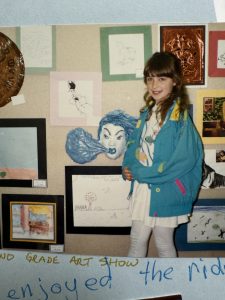
Yes. I was really interested in art when I was little, and started taking extra art classes at my elementary school. My family moved [from Charlevoix, Michigan] to South Carolina, where I [was part of the] inaugural year of an arts boarding school [the South Carolina Governor’s School for the Arts and Humanities] modeled after Interlochen [Arts Academy]. There were arts foundation programs: still life painting, 2D and 3D design. Photoshop had just come out, so there were classes on digital work, and there were classes on how to take your own slides and images. That was the second half of high school. I feel like I got a jump start on art school.
I went onto art college at the Kansas City Art Institute [2001-2005, earning a BFA in painting and art history]. It was appealing to me because it was a small program that felt like an artist’s colony. There was an old-fashioned campus from the 1800s set up next to the Nelson Atkins Art Museum — their Met in Kansas City. My studio was across the street, and I had a young woman who was my painting teacher; and a lot of older, male artists [teachers] who’d been there since the 1960s. It was inspiring. There was a connection to Abstract Expressionism through the museum, and to these painters from the 60s. But then I had my teacher Leeah Joo — she was only 30 at the time. She’d just finished the painting program at Yale, and came [to KCAI] to teach. Being a female artist, that was inspiring to me.
I took a break after that. I taught art in Boston at an elementary school. And then I went to [Dallas] Texas. I got a full scholarship to Southern Methodist University [within which is] the Meadows School of the Arts. They only take six-to-10 graduate students a year, so it’s a small group. It’s intense. There was a lot of art theory, art history and studio practice. [Colleen received an MFA in 2011.] And then a lot of things in Dallas that were really inspiring. We were invited to exhibits and shows all the time — there’s a lot of money in Dallas, and a lot of support for contemporary art. While I was there, I was figuring out where I fit in the art world. There was a teaching assistantship, too. It’s a lot to pack into two years, but I learned a lot. I don’t think that I could figure out what I wanted my work to be about until [she’d left and was able] to process it all.
How did your formal training affect your development as a creative practitioner?
I feel like a lot of it was training, and to see how long you can keep up the momentum. If I look back at my sketchbooks from high school, I feel like what was there is still there. [Her academic training] taught me how to connect my eye and hand, and how to look at things harder. I feel like I was doing a little of that on my own, but it got developed more and more.
How would you describe your painting style?
It’s Impressionistic. I like thick applications of paint: I like the juiciness of paint, that’s why I like to paint. It’s expressive — I put my emotions into my painting. I don’t like to overwork paintings. I like them to [express an] openness of movement.
Describe your studio/work space.
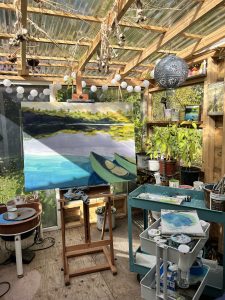
I have a studio in Traverse City [Michigan]. It’s part of a bed and breakfast downtown. I have the whole bottom floor. I paint outside a lot, so at home, in my garden, I made a seasonal studio that’s built off our sauna and greenhouse. It’s more like an art school/summer retreat studio for me. It’s like the kind of place I got in school, a little 10’ x 10’ space. It’s a shed on one side with a door onto a painting deck.
What are the themes, the focus of your work?
Nature. I’m rooted in the tradition of plein air landscape painting, waterscapes, landscapes that focus on that floating, watery, fluid feeling without many land masses. I really love the waterscape element of the landscape. I paint a lot of flowers; it’s its own subject, but I feel like it’s a zoomed-in view of the landscape. I was doing a lot of still lives at first — picking flowers, putting them in a vessel, painting reflections. Lately, I’ve been setting up my easel next to the flowers in the garden and painting them in the wild, with the landscape flowing behind them.
You can’t control flowers outside as well as you can control cut flowers in a vase in your studio. Does that ever play into your interest in painting outside?
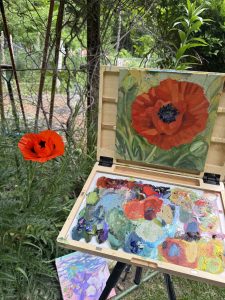
I think it does. There’s an element of excitement when you paint outside. You’re responding to so much. When you’re in the studio, you’re hyper-focused, controlling the elements and making what you want. There’s a level of spontaneity painting outside. I can’t predict what’s going to happen. I can’t plan it out. I can do that in the studio — making sure the lighting is what I want, and the setting is neat. I think my true passion comes from painting on site, responding to things I didn’t plan out. There’s a level of adventure, too. The element of surprise, discovering on the spot and figuring out what to do with that is why I like painting outside.
What’s your favorite tool?
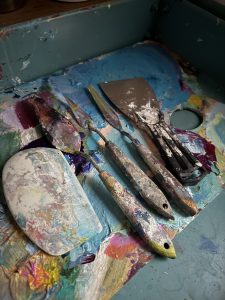
Palette knife. I use brushes a lot, but I’ll apply paint directly with the palette knife. Sometimes, if I don’t like where a painting is going, I’ll switch to a palette knife, and the painting opens up and changes for me. A palette knife gives me the ability to put more paint on the surface. With a brush, sometimes, I can get a little too nit-picky. If you take a palette knife [to the painting], you can knock out something, or start over. As you lay paint on, [the composition] starts to have a lush, tactile feeling. I feel like it makes the painting come alive.
Are your surfaces more three-dimensional because of the palette knife?
I like there to be a surface that isn’t just an illusion, but physical.
Do you use a sketchbook to make notes and record thoughts about your work?
I like to use the Moleskine sketchbooks a lot. I was in a really good habit for a long time. Anytime I went to a museum, I’d bring a sketchbook. It’s not like you want to emulate the other artist’s work, but it gives you ideas [to record]. I don’t feel like I use a sketchbook as much as I used to. When I do commissions, I tend to sketch because I like to get the client on the same page. I usually bring a sketchbook to the beach — I’ve been drawing my kids a lot. Usually I write on the cover of my sketchbooks the year or where the sketchbook was used — I have a sketchbook I took to France. And they look nice in your art library. It’s an archive of my work, too.
Why is making-by-hand important to you?
It’s something I feel compelled to do. It’s part of who I am, how I express myself. I notice if I don’t do anything like that for a while, something starts to feel off; I don’t feel like myself. I respond to things made by hand more than I do to [things made by] machine. I feel more connected. Digital art, having iPhones and computers and iPads: I know a lot of friends and artists who really find those tools appealing, but I still like [the work she does] to be by hand. I would have been happier living [in the 19th Century].
When did you commit to working with serious intent? What were the circumstances?
Midway through art school it hit me that if I’m doing this, I’m doing this. I need to come up with a thesis. I’ve got to show that these four years of putting in all this time, energy and money into art school is worth it. I think my school really treated us like professional artists. The respect and talking [to the students] about what you can do with a degree in art … I was in my early 20s.
What role does social media play in your practice?
It’s a way I feel connected to other artists, to what’s happening. You used to read the art magazines to what was happening; now it feels like you’re on social media to see what shows are at what museum, what are the trends in contemporary art. I’m connected with my friends from art school, undergraduate and graduate school. I also post what’s happening in my studio. I was really into it for a while, but I haven’t been as excited to use it lately. I feel like a lot of the social media stuff changed in the last five years. When I first started using Instagram, I felt like a lot of artists were connecting [through the platform]. Now, it’s more about ads and [what the algorithm migrates] to the top. I know it changed. I used to post [images of] paintings, and I’d get a thousand views in the first few minutes, and people commenting from all over the world. Then it slowed down, and it felt like it didn’t have the same reach. I haven’t taken on the full marketing potential of it. I feel like that’s a whole, other job from being an artist. It’s hard to manage your social media, your studio, marketing yourself. Ten years ago, no one needed to social-media market themselves as an artist. That wasn’t the artist’s job. Now, it is your job. The galleries and the shows used to do that. You can control your own image, but it’s a lot of hard work.
What do you believe is the visual artist’s role in the world?
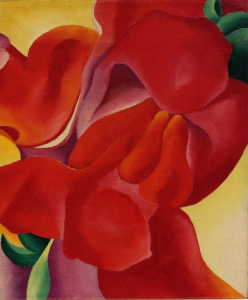
There are multiple roles. It’s to share what you see. Share your perspective. So many times I’ve gotten comments about my work from people who love how I’m seeing the world. I paint a lot in pink. My husband said that sometimes, when he sees things from my view, it’s like that saying: looking through rose-color glasses. I also think [the artist’s role] is to open up people’s eyes to the beauty that’s around you. There are so many instances where art [provides] social commentary, which opens people’s eyes to other things that are happening. During the Industrial Revolution, people started painting the factories, and [people realized] that these were paintings of smoke taking over the romantic landscape. It was about pollution. It was a warning: Don’t take for granted the beauty that surrounds you in nature. Georgia O’Keeffe painted six- and eight-foot flowers. People asked her why she was painting a flower this big. And she said it was because people aren’t looking. You have to look at this tiny thing that I painted large. You can’t ignore it.
How does living in Northern Michigan inform and influence your creative practice?
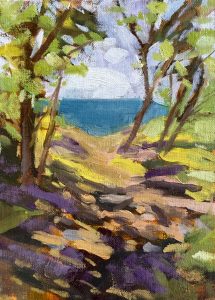
Right before I came back to Northern Michigan — I moved away when I was 11 — I remember coming back and being wowed: The four seasons are so magical. I’d been living in places without four seasons for years. I didn’t remember [what the four seasons were like], and felt I was experiencing them like a kid again. I’d been in L.A, Texas, and South Carolina for so long. Coming here and [experiencing] the spring: the blossoms, the color. It was so magical. Being back in Michigan, I liked that the landscape changed almost every three months. I felt like I got a fresh perspective every time the seasons shifted. That was really inspiring for my work. I feel like it impacted color choices, surfaces, what I felt drawn to paint. That’s part of the reason I started painting the flowers [she was growing]. They’d bloom, and I’d want to capture them. I loved the shadows in winter. Everyone complains about winter, but I thought it was amazing. I hadn’t been in a snowy place in so long. So, when the sun came out, and there were blue shadows from the trees on the snow, I just wanted to be painting it.
Did you know anyone, when you were growing up, who had a serious creative practice? Who would have been a role model for you?
I was exposed to various artists when I was young, and that probably impacted me. My mom was a watercolor painter. She did it for fun. Both of my parents were creative. My dad ran a sail loft in Charlevoix, making sails for sail boats he designed. My parents were friends with the owners of Koucky Gallery [formerly located in Charlevoix, now located in Florida]. Chuck Koucky is a potter, and I’d do pottery with him. We had a lot of art in our house. My parents had what they liked on the walls. A lot of my [childhood] friends didn’t have art in their houses. They’d come over [and say], Your parents have a painting of a naked woman in the dining room. That’s so weird. I had an art teacher [at the South Carolina Governor’s School for the Arts and Humanities] who did a lot of weaving and natural fiber work, so I feel that [her early role models weren’t all painters]. She had some exhibitions that I went to.
Who has had the greatest and most lasting influence on your work and practice?
Leeah Joo [suggested] that I go to this summer intensive in Western New York called Chautauqua. Stanley Lewis taught there. He was in Kansas City in the 60s but ended up leaving. [At Chautauqua] every morning, he’d take a group plein air painting. Of all of my painting teachers, I like best the way he paints. He was an obsessive painter who looked, and looked, and looked. He gave each of his students time. He’d come around and sit, and look at what you were working on, and say, Tell me what you’re looking at. Stanley’s intensity — it was who he was. And I thought that that was the kind of artist I wanted to be. I didn’t want to separate my persona from what I do. I AM a painter, and when I met him, I felt that. It seemed as though Stanley would wake up and start looking at things, responding to things.
Where or to whom do you go when you need honest feedback about your work?
Lately, I’ve been asking my kids [for feedback]. Sometimes I ask my partner. I still send things to my mom. But, a lot of the time, I ask my kids. They’re artistic. My son has become a painter in the four years. Usually, they’ll say what they think. They’re 12 and 13. They’ll tell me if they think [the painting] is done, or if I need to work on it some more. Over the years, I’ve gotten more confident and don’t feel I need as much outside feedback as I’ve gotten.
It’s obvious that exhibiting your work is important to you. I’d like to talk with you about the art fair part of it. Art fairs are hard work. Why do you do them? How do they fit into the ecosystem of your practice?
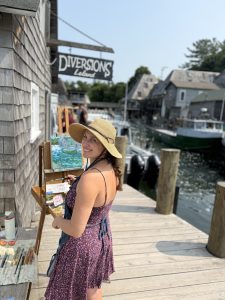
The first few art fairs were fun. Then I went through a period when I thought they were more work [than she wanted to do]; I’m not getting enough of an outcome. I had to figure out which were worth doing. I have to do the fine art fairs. The people coming to the craft fairs aren’t looking for paintings. I’m not the kind of person who’s doing an art fair every weekend in the summer. You need to have a balance. Last year I did the Fishtown Preservation Society’s Art Shanty. I feel like that’s an art fair/artist’s residency. The little shanty is like your booth — you don’t have to set up a tent. What’s hard about an art fair is getting all your [inventory, infrastructure such as the art fair tent] together. You need a lot of support. There’s always a mix of people who are sincere about looking at your work. It’s invigorating to talk to that many people. It’s also socially draining. You’re on. You’re also selling yourself. I find that part draining. I like having my work in a gallery where the gallerist is promoting your work. I have started bringing my easel to art fairs. When there’s a lull, I can be painting. If someone comes to talk to me, we can talk about painting. Sometimes I’ll sell the painting off the easel. The other benefit [of exhibiting at an art fair] is that the work you show is curated by you. You’re able to control how people see your art. All my paintings get to relate to one another. There’s not another painter’s work next to mine [as there might be in a gallery]. There’s more of a wow factor when you’re doing that.
How do you feed/fuel/nurture your creativity?
The seasonal shift helps me a lot. If I haven’t gone plein air painting in a while, it’s making sure I go out. Sometimes, it’s just going some place new. That gives me some new momentum.
What drives your impulse to make?
Translating what I see: It’s an inner drive that I’ve always had. The hard part for me in my MFA studies was that there was so much analyzing and thinking about work — whereas I respond more to just making. I’m process oriented: I like to discover through painting. And that feeling of flow: It’s one of the only things [that allows her to] get lost in what I’m doing. You forget to eat, to go to the bathroom, what you have to do later. You’re just lost in this moment. I like to be in that state. The process drives me.
Read more about Colleen Gleason here.
Sarah Bearup-Neal develops and curates Glen Arbor Art Center exhibitions. She maintains a studio practice focused on fiber and collage.