 Exhibition: June 5 – August 13, 2026
Application period: Through April 7, 2026 at 2 pm EST
What This Show Is About
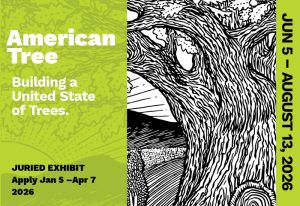
American Tree is an examination of the role trees played in the formation of the United States 250 years ago — and the role trees will play moving forward into this nation’s next 250 years. This exhibition will be a celebration of trees; a vehicle for exploring and interpreting the pivotal role trees played in the history of this nation; in shaping its values, its mythology, its ideas about its place in the world. At the same time, American Tree is an exhibition that asks what our relationship with the forests and woodlands looks like today? Is it purely transactional and commercial? Is there respite and renewal to be found in the woods? And what is our blueprint for the forest ecosystem in the next two centuries? What does a United State of Trees look like? Why should we care?
Some Thoughts On Things They Didn’t Teach You About The American Revolution
The Backdrop. At one time this continent was rich in trees and virgin forests. According to Eric Rutkow, author of American Canopy, “Geographers estimate that woodlands covered about 95 percent of presettlement New England and contained three-quarters of a million trees for every 10 square miles.” This got the British monarchy’s attention:
- As early as 1605, the British believed North American expansion was the key to its future, and all those trees guaranteed “the colonial venture would succeed financially.” [The Brits had begun to actively deforest their own island in the 1500s for fire fuel and, later, for wood-fuel driven manufacturing.]
- In order to maintain global dominance, Britain needed ships. Your standard-issue naval warship required about 2,000 mature oaks [an estimated 50 acres of trees].
- White pine and fir trees were the preferred wood for these vessels’ masts — not your Charlie Brown Christmas tree, but giants that towered more than 100 feet high, and measured more than three feet at their base.
- Among the many things that ultimately soured the British colonialists on King George 3rd, and fomented the desire to peel off the North American continent from Britain’s holdings, was a late 15th century charter. It declared the king’s right to harvest all the really big trees.
After The Revolution. So many of the beliefs we have about trees today were formed in the earliest years of this nation’s creation:
- Colonial settlers regarded the forests as frightening places. The native inhabitants — both two- and four-legged — were also included in that basket. How have these perceptions come through time and history?
- Our belief that public servants need to adhere to the highest moral standards got its start with a cherry tree, the one six-year-old George Washington cut down. Confronted by the results of his handywork, Young Washington said, “I can’t tell a lie, pa … I did cut it with my hatchet.” It’s apocryphal, but this myth informs our nation’s origin story. How’s this teachable moment holding up?
- In a time before cameras, there were painters. In the 19th century painters associated with the Hudson River Group were able to convey the breathtaking beauty of the continent’s western territories in their landscapes. They articulated a love of these vast woodland places, which caught on with the public, initiated a shift in thinking, and laid the groundwork for a conservation ethic and movement. How’s this working? Read more here: https://www.nps.gov/articles/conservation-movement-art.htm
Looking For
Visual art in 2D + 3D, made by the applicant between 2024 – 2026.
Innovative, fresh responses that move beyond the easiest answer. We’re looking for work that not only celebrates trees but explores and interprets the pivotal role they played in the history of this nation, its values, its mythology, its ideas about its place in the world; what that looks like now, and in the future.
Open To
2D and 3D work including paper, clay, fiber, metal, wood, glass, drawing, painting, printmaking, furniture, mixed media, photography, weaving, sculpture, stitchery, and more.
Size Restrictions
- 2D work should not exceed 48” in total width or 65” in total length.
- 3D work must be freestanding and easily moved, not to exceed 35 pounds; or 48” in total width or height. Because of companion programs planned in conjunction with the exhibition, 3D work will be occasionally and temporarily relocated in the gallery and in the GAAC.
Application Fee
Applicants may enter up to two [2] submissions for the juror’s consideration. $25 GAAC member, $35 nonmember. This is a nonrefundable fee.
Exhibition Calendar
- Exhibition runs June 5 – August 13, 2026
- Apply online: Through April 7, 2026 at 2 pm
NOTE: The GAAC will be closed for Spring Break on Sunday, March 29 through Sunday, April 5. Re-open Monday, April 6. Applications may still be filed, but there will be no GAAC staff available to help with questions March 29 – April 5.
Notification of acceptance: Mid-April.
- Shipped work deadline: May 22 – 28, 2026
NOTE: The GAAC will be closed for the Memorial Weekend on Monday, May 25. No one will be present to accept deliveries.
- Drop-off: Friday, May 29, 9 am – 2 pm; Saturday, May 30, 9 am – noon
- Reception: June 5, 2026, 5 – 7 pm
Jurors
Julie A. Avery has worked as an arts educator and specialist in public education; and museum curator, educator, and administrator at Michigan State University. She utilized these experiences within Michigan Extension where she championed arts, history, and heritage as strategic elements for community and economic development.
All along the way Julie participated in arts workshops and her own creative work. Since retirement from MSU and moving to Empire, Michigan in 2011 she has pursued pastel painting investigating light and color through landscapes, trees, and people. Julie has exhibited her work regionally and in the Keweenaw Peninsula. She remains active with cultural nonprofits, currently as Vice President of the Michigan Barn Preservation Network and serving on GAAC’s Exhibitions Program Committee.
Paula Jo Kemler loves living in Glen Arbor surrounded by the beauty of Northern Michigan and appreciates how this area inspires creativity in herself and others. Paula earned a degree in Classics from Miami University, Ohio, with an emphasis on ancient Greek art. Her studies took her to Athens, Greece, where, in addition to coursework, she worked on an archaeological dig. She has participated in arts classes, is a member of the GAAC Exhibitions Committee, has served on the board of arts organizations and is an enthusiastic gallery goer keen on experiencing different perspectives. It is an honor to serve as a juror, a task that allows for deeper observation and understanding of what the artists are expressing through their work.
Awards
Three awards will be given: $150 Best of Show; and two, $75 Merit Awards. These awards are made possible by Barbara and Victor Klein Art Fund.
Photographs
You may submit up to 2 works for the juror’s consideration.
You are required to submit an image of the overall work. You also have the option of providing 1 additional, detail image per work submitted. Please provide well-composed, focused images of your work. This is the work people will view online. Present your work as well as you possibly can.
- Do not photograph 2D work behind glass.
- If framed, do not include the 2D artwork’s frame in your exhibition image unless it is part of the composition vs. a finishing detail.
- The image should show ONLY the work you want considered by the juror. Please photograph your work in a space that is completely neutral, and does not contain objects that are unrelated to the work you want considered by the juror.
The American Tree exhibition will be installed in the GAAC gallery, and will be viewable as an on-line gallery on the GAAC website.
Requirements
- Work submitted must be one-of-a-kind, innovative, and original in design. Work derivative of other artists, or work created in a workshop or classroom with the collaboration of an instructor is not accepted.
- Images generated by artificial intelligence cannot be considered. The use of generative artificial intelligence, such as generative fill, to manipulate photos is also disallowed. All parts of the image must have been photographed by the artist who holds the copyright to the work submitted.
- An entry may be comprised of multiple units [e.g. a diptych]; but may not exceed the maximum dimensions or weights described below. If offered for sale, a single entry comprised of multiple units must be sold for one price. The individual units may not be sold separately.
- Work submitted must have been completed in the last two years [made from 2024 – present].
- Work must be gallery ready, when submitted. Paintings and other wall works should be finished or framed. Please use gallery wire. No saw tooth hanging hardware is allowed. NOTE: Wet paintings, work submitted on warped canvases, work that has evidence of pet hair, food stains or other marks/detritus that are not an intended part of the composition will not be exhibited. Exhibitors will be required to bring their accepted work up to gallery-ready standards before they are allowed to be part of the exhibit.
- No work will be accepted after the dates and times for delivery listed on the prospectus.
- The artist’s contact email provided on the application must remain active during the submissions and exhibition process. The artist is responsible for checking their email for exhibition acceptance and/or decline, and other information regarding the exhibition.
Artist’s Statement [REQUIRED]
American Tree applicants must submit a short [100 words max] statement that provides context for looking at the artwork. How does your work respond to, and answer the creative problem at the heart of this exhibit?
Sales
• The sale price written on the application is the FINAL price if the work is accepted in the exhibition. Exhibitors may not change sale price after the work is accepted for exhibition.
• The GAAC will retain a 40% commission on work sold during the exhibition. Artists receive 60% of the final selling price. Artists will receive payment following the close of the exhibition.
NOTE: The GAAC staff and Exhibitions Committee reserve the right to make the final selection of work to be shown in the exhibition. Accepted work may not be removed before the close of the exhibition.
For More Information
Contact Sarah Bearup-Neal, GAAC Gallery Manager: (231) 334-6112.