Creativity Q+A with Kristina Pepelko
During the COVID pandemic, Kristina Pepelko, 36, had an I-can-do-that moment, and what she decided to do was to launch herself as a typewriter poet. This Grand Traverse County resident turns your words into a poem — either on the spot, or during an open subscription period — one keystroke at a time on her trusty Smith Corona. No AI here. Just slow, considered creative work.
This interview was conducted in June 2026 by Sarah Bearup-Neal, Glen Arbor Arts Center gallery manager, and edited for clarity.
You are a storyteller — in two different worlds. Tell me about your day job, and the stories you tell through it.
In my day job, I work with the Grand Traverse Regional Community Foundation. I’m their director of strategic communications. For that I do all the marketing communications for the organization. A lot of the stories I’m working with are about our community impact, donor generosity, and the magic of working together to power a positive change. That storytelling takes a lot of different forms. It could be social media posts. It could be long-form articles, or blog posts. It could be in our annual report, newsletter email.
Now, tell me about The Typewritery, and the kinds of stories that come out of this project.
The Typewritery is a bit different. It’s not a full-time job. It’s not even a part-time job. It’s a pop-up studio that’s focused on custom, original typewriter poems and poetry experiences. It’s a fun, creative side project [that] I designed as a pop-up specifically so that I can better manage my time and energy, and always be producing. I write the poems based on the topic or theme that people approach me with, whether it’s in-person or if I have an open-order season.
What does an “open-order season” mean?
I can pop up in person, which I’ve just started doing this year.
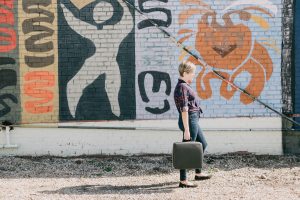
But generally, I have one-to-two open-order periods, so if you [subscribe] to my newsletter or social media, you hear about when I might have these one-to-two month order seasons. They’re either structured around [the client] selecting the theme or topic; or, I’ve just started this year something called Poetry Prescriptions, modeled after the Poetry Pharmacy in the U.K. They offer poetry prescriptions in little vials that are quotes from poems. Instead of doing that, I selected topics that people could select from. Poetry Prescriptions are thin and short. The in-person poems, which I call mini-poems, about a quarter page [in length], I only have 10-to-15 minutes to compose them.
What kind of container do your Poetry Prescriptions get housed in?
They go by mail, in an envelope. I’ve started using handmade paper. It’s really texturally interesting, and feels significant, like it could be an art piece.
What are the other vehicles for creating poem?
I’m hoping to offer some cool, unique things that you wouldn’t encounter with your typical typewriter poets. The standard offering I’ve seen are in-person pop-up events on the street, or you could order a custom poem. I’m hoping to try a poetry buy-in: You buy-in at a low rate and submit one word; I collect all the words submitted, and the poem includes all of the words. I did that when I did The Typewritery launch.
What are the circumstances that spawned the idea of The Typewritery?
I’d encountered typewriter poets and writer — people who write mini-stories and non-fiction — in New York, New Orleans, in bigger cities. What I was seeing most often on the ground was [the writers] were usually men. When I saw that I thought, I can write poetry, and typewriters are cool. It doesn’t have to be a male-dominated field. As I’ve expanded more into the typewriter world in social media, I do see a lot more women doing it. So, I had a I-can-do-this-too moment. I started it during the pandemic — that’s when we all had lots of time. I was living in Baton Rouge [Louisiana], and a friend knew I was interested in trying this out for fun, so she found a [Smith Corona] typewriter for me at an estate sale for $35. It was special that it was a friend helping me get started, and that the typewriter was passed down from someone else. I had a launch party in 2021 for friends and family. I started with custom poems only. During that period I was writing birthday poems, anniversary, gifts for people for themselves, and gifts for other people. It was a wide range of requests.
So, I come to you and say, I need a poem for my dog.
Yes. I’ve written dog poems.
What’s the process you go through to gather the material you need to make a poem?
It depends on how the recipient is approaching me. If it’s in person, I have a short period of time [to compose]. If I have some time to talk with them, I’ll get their dog’s name, ask them what they love about their dog? What’s a silly thing your dog does? What does your dog like — three to five questions that will help me understand the personality of the dog. The poem is still based on my creative expression, but it allows me a little bit of a container to bring in those details. With any poetry, with this style or with literary poetry, the more specific you can be, the more interesting and personal it can be; the more resonant it can be. If it’s a custom order, in my order form I ask for some specific details and questions. That allows me to go back and email them for more information.
Why do you think a poem is a meaningful gift?
I think that poetry is always meaningful. It’s one of the few forms that we bring into life’s most commemorated events. They show up at weddings. They can show up at births. They definitely show up at deaths. Even the presidential inaugurations with the poet laureate. You see [poetry inserted] into these key life or civic moments. Even if someone considers poetry a less-read genre in the literary world, it’s actually the most-infused [literary form] in our every day lives. It creates a special gift for people because there’s something resonating about the language of poetry, and how it speaks to personal experience. It can sometimes say things about how we’re feeling or experiencing the world that our everyday language or words can’t. It captures a moment in time. There’s a timeless quality to poetry as well; you can keep re-reading it, whereas you might not always re-read a novel. A poem is easy to access that way. Poems from The Typewritery are one-of-a-kind creations. In this day and age of AI, it’s an analog experience.
How did poetry and creative writing fit into your life before The Typewritery?
My foray into poetry was back in early elementary school. In the second or third grade, we were given journals. Everyone was [referring to the books as] “my diary.” I sat there and went, Oh, this is my poetry journal. It wasn’t my first interaction with poetry; children’s books are always full of poetry and rhyme, but it was my first, concrete, this-is-mine [journal] to write poetry in. I was writing poetry at that age, and throughout middle- and high school as well. Then, I went onto college and got my bachelor’s in English and Writing at Grand Valley State University [in 2012; a master’s degree in public administration followed in 2019, also at GVSU]. For the writing [part of the degree], my two specializations were poetry and fiction. I continued to write, but less often, since I’ve been in my career field. The typewriter has been my opportunity to bring back poetry.
Talk about the typewriter itself. What are its qualities and characteristics?
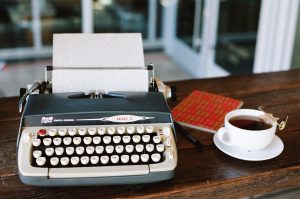
The typewriter I use is a Smith Corona. I don’t actually know a lot about typewriters. If I come into a situation where I have to fix something, I have to YouTube it; there’s no one I could take a typewriter to to fix it. I don’t know a lot about its personal history, but I know [a Smith Corona typewriter] is a favorite for many people. For me, the typewriter is a unique tool. It creates a unique experience. I also see it as the carrier of history because it came from someone before, and then it’s from a different time period we don’t interact with anymore. What’s really unique about it is any typewriter allows you to slow down. It’s a slow process even if you’re a really fast type-er like I am on a normal keyboard.
That not-being-able-to-type-as-fast on the typewriter keyboard: How does that affect the thinking-through you have to do in the creation of a poem?
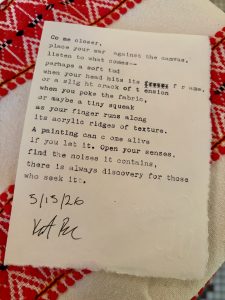
I have to stop a bit more to consider. The typewriter is an imperfect machine. Yes, you can use typewriter correction tape but I can’t because of the paper I use. It’s either parchment, off white, or handmade so you’d notice [the correction] more, so I allow the errors to be in there, and X them out; or just allow a typo to be a typo. The slow typing requires me to slow down — so I can avoid errors, and also to make sure each letter counts. I’ll handwrite and brainstorm the poems on a blank sheet of paper first, and then I’ll type them. That’s how I write, in general. It slows my mind down and allow me some more creative freedom.
I’m struck by what you said about going to YouTube to figure out how to fix your machine. I can’t even imagine doing that with my laptop. It’s an entirely different machine. It’s not for the common person to fix; it requires a specialist. But the typewriter is this beautiful mechanical thing that is like a car before all cars were computerized — you could get in there and change your own spark plugs.
It’s not an overly-complicated vehicle for expression. It is fixable. Most of the You Tube [typewriter repair] videos are older, maybe like 10 years old, and not much changes with the typewriter; they’re not producing them anymore. Every typewriter has weird quirks with the keyboard. So, mine will sometimes create odds spaces between a word or a letter. There’s some fix that you can do, but it’s just the nature of [the machine]. Some letters are stronger with ink than others. Sometimes, with the line [spacing] of the poems, they’re close and sometimes they’re spaced apart, so I have to figure out the spacing as I go. I had one issue, where the long keys [crossed and] stuck together. I had to figure out how to fix that.
I’m interested that the typos become part of the aesthetic of the poem. We’ve become so used to having pristine copy come out of our writing machines. So, does typing on a typewriter feel like you’re flying on a trapeze without a net? Once you strike that typewriter key, you’re committed.
I have sometimes re-started pages, which always makes me sad because I waste paper. I tend to be OK with mild typos, or things that I can X out quickly. If I’ve done consistent errors, then I start again. Usually, I’ll do a test sheet. It’s on the spot. You have to be flexible with it — you can’t really delete it. I try to preface, when recipients order or meet me in person, that this is a custom piece, but it’s imperfect because of the imperfections of the typewriter. We’re so used to the perfection we can get from our digital tools.
You have a disclaimer on your website that the poems you create are “original typewritten poems — no A.I.” Why did you feel it was necessary to make a distinction of this sort?
I did update [the statement] on my social to just say “Original custom poems.” I don’t use A.I. to create the poems. I originally made that distinction because we’re in the age of A.I., and there’s a lot of A.I.-created content out there. What I see on social media is an anti-A.I. movement. People still want the content people create from their own thinking, with their own hands. I took away the reference to A.I. because it isn’t part of my writing; none of the poems are put into A.I. in any way, or edited by A.I. But if I’m doing research, there’s already an A.I. summary that comes up, so I can’t avoid A.I. anymore unfortunately.
You also have another interesting characteristic of the project: You use the U.S. Postal Service to mail poems to recipients. Talk about the qualitative differences between emailing something, and actually taking it to the post office and posting it. Is there some added goody that comes with getting something in your mailbox?
Yeah. I think so! Again, in the digital age, we’re used to getting texts and emails, DMs. Very few people get mail — you might get junk mail, maybe you still get the paper or greeting cards, but very few people actually get personal mail anymore. What I’ve found is the recipients love getting [their poems] in the mail. They like that it’s random because there’s no tracking on letters, so it can come in five days or 10 days; or if they live internationally, it can take a month if the mail is slow in their country. It’s a surprise for folks even if they know that it’s coming. They love the mail experience — getting something special for them or for someone they love. It’s very tactile, tangible. I love the packaging process of mailing the poems. I pay attention to the paper I use for the poems; but I also pay attention to the kind of envelope it’s in. The address is handwritten. I seal them with a wax seal [which] harkens back to a different time. The whole package matches the slowness [of the process]; it slows people down. We’re in a hyperconnected, fast-moving world, but it’s something you can savor, and it doesn’t go away. Many people who order a poem end up framing them. It becomes this special gift they can keep coming back to.
I can’t help but think of the interesting stamps that continue to be issued. They’re artful, and intriguing, and commemorative. What kind of stamps are you drawn to?
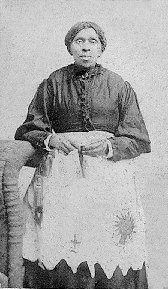
I love picking stamps that are unique. 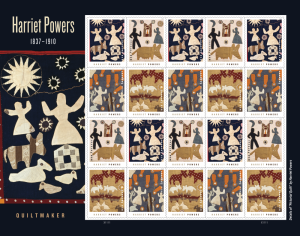 Each order season, I choose a different stamp. Right now there a stamp [commemorating] a famous quilter [Harriet Powers] — again, that’s a slow, handmade art form, so I love that paired with this year’s [poem] orders. I love the stamps with scenic photos, or unique flowers; but I don’t use the flower stamps they always have on offer. I don’t use the U.S. flag stamp. I stay away from the stamps people see all the time.
How do you feel that your typewriter, and the creative things you do with is, is an ambassador of things made by hand?
It’s different from quilting, things like that; but I see it as an opportunity for people to experience slowness; a different orientation to art, and to poetry in particular. Poetry, in the literary space, can sometimes feel inaccessible to people. It can be abstract sometimes, [written] at a higher level of knowledge or language use. I find that this poetry, because it’s created on the spot, or in a short time frame, is more accessible. It’s something people can get right there. It’s personal to them or to their loved ones. It’s an ambassador for making a one-of-a-kind experience.
What’s the role of social media in your practice?
Social media is a marketing tool. It’s a connection tool with folks I might meet on the ground. It’s marketing and community-building in one. I try to post semi-regularly, once a week. It’s interesting. You go from slow-typewriter creation to fast paced, needing to market yourself and your work so you can draw more people to it. It’s more closely related to my day job than my creative project. While I can engage well with social media, I find, after hours, I’m uninterested in it. I’d rather focus on creating or connecting with people otherwise. I’m trying to drive people to my email list or newsletter. I only email when I’m ready to open up a new poetry offering season or event. That pairs better with The Typewritery project because it’s slow, and you can customize it: Social media is run by algorithms. Emails are run by peoples’ consumption of the email.
I’m interested in the thoughts you may have had over the years about the role of creative practitioners in the world. Why do we need them? What do they do for us?
Creative practitioners create meaning and connection for us in ways that we might not otherwise experience the world. They also help us make sense of the world through a unique lens, and how we relate to other people — especially in today’s fast-paced, digital-driven culture. Creativity allows us to slow down. It allows us to share experiences. It allows us to connect to others. It reminds us of how we’re together in this world, and I think it can bring us closer. Especially with my approach, I think writing is empathy, and creative work can help us connect to the empathetic, human side of our experience. That’s why we need creative people in the world, and to have them keep creating what they like.
Did you know anyone when you were growing up who had a serious creative practice?
My family is from Croatia; my parents are both immigrants. They both grew up in rural poverty. My mom grew up in a home with dirt floors, and lived off the land, creating things for themselves. In those environments, your creativity is more practical in orientation. You need to survive. It doesn’t get to be in the forefront. You have to make money. I know that my [maternal] great grandmother was a seamstress. She sewed all of their linens. That skill was passed onto my grandmother, who then took up needlepoint later in life. My mother liked to draw. My dad was an electrical engineer, so he did a lot of drafting by hand. My sister, in high school, was an artist. That infuses into my work beyond The Typewritery, in my fiction and nonfiction or literary poetry, which is different from the typewriter poetry. My biggest creative influences were my college professors. Patricia Clark was my main poetry professor; and Caitlin Horrocks was my main fiction professor. They were just excellent advocates of my work, really believed in it and championed it, and provided me with resources and support I wouldn’t have had otherwise. There is also a musical background in my family — my grandfather on my mother’s side played the violin and enjoyed fiddling, and both my sister and I played the violin, me from upper elementary through high school. My mother also liked to sing and sang in a choir at one point in her younger years.
The thread that runs through your family is all these people are doing creative things whether or not they’re practical or impractical. You have in your DNA and heritage this creativity that has come out in a different way. So, I’m wondering, what does your family think of your poetry-writing side venture?
That’s interesting. They’ve been supportive of The Typewritery, and generally supportive of the creative writing I do, but when I was pursing English and writing as a degree, that was harder for them to wrap their minds around. It’s not practical in the sense of a clear career path. I’ve carved out a nonprofit marketing and communications path for myself [which is] a great career path for people who study those subjects; but my parents were immigrants and had to exist in a world that was practical, in a world where it was clear you could make money so you could survive. When I was [in college] there was hesitation and confusion around why I chose English and Writing instead of pre-med, or pre-law, which are the two typical desires of any immigrant parents for their children. Now, they’ve seen you can do both, and you can make money off of creative writing — I could turn the typewriter into a full-time gig, but I don’t want to.
How do you charge for your services?
I charge in the tradition of other typewriter poets. If I’m doing a private event, it can either be that the host allows the guests to pay their own way; or the host pays — that’s a set fee. If I was on the street or hosted in a casual event, as well as when I do mail-order custom poems, it’s choose-your-own price. That’s the tradition of the street typewriter poets. It makes the work more accessible so regardless of your income level, you can get a poem. It varies, but most people pay $20, $30, $50. Generally, people are quite generous. I’ll accept anything. If they don’t have cash they can pay for their poem with Venmo.
Read more about Kristina Pepelko and The Typewritery here.
Sarah Bearup-Neal develops and curates Glen Arbor Art Center exhibitions. She maintains a studio practice focused on fiber and collage.