Creativity Q+A with Kim Bazemore
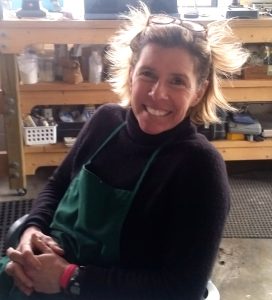 Kim Bazemore, 60, grew up in Atlanta and thought she was “either going to study architecture or international issues and go work for Coca Cola in Spain.” Instead, she found Northern Michigan, beach stones, and metalsmithing. Kim traded Atlanta for a home and a handcrafted life on Grand Traverse Bay.
This interview was conducted in November 2025 by Sarah Bearup-Neal, Glen Arbor Arts Center gallery manager, and edited for clarity.
Pictured: Kim Bazemore
Describe the medium in which you work. What is your work?
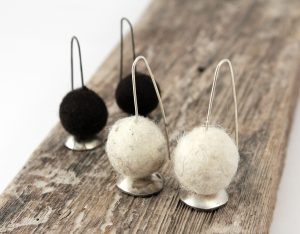
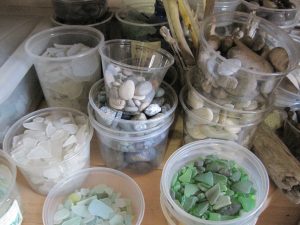
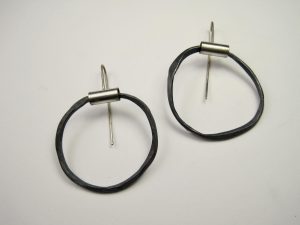
I’m a metalsmith. I make jewelry, mostly sterling silver. I’ve used gold. I’m into brass now. I incorporate beach glass and beach stones from Lake Michigan; some semi-precious stones; beads I find interesting. I’ve also just found some really cool, Japanese-made beads that have a contemporary look. I don’t set any boundaries about what I can incorporate into my jewelry, so I use leather, felted roving that’s local, things like that.
One of the things that’s interesting about the collection of some of those materials is that it involves walking the beach. With your dog. Talk about that.
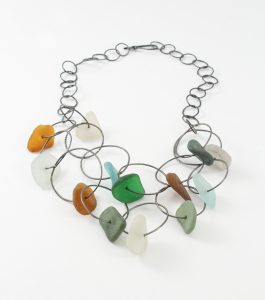
Thirty-eight years ago I moved up here, to Glen Arbor, and I walked the beach — just to take a look at what I thought looked like an ocean out there. But I also looked down at all the cool stones, and I found some beach glass. I’d never seen beach glass before, even growing up on the East Coast — we always looked for shark’s teeth. I thought it was really cool because it was sand blasted [naturally]. I picked up a bunch, and thought about how well they’d go with sterling silver — shiny silver, sand blasted matte finish glass: It was a great contrast. I’m still collecting beach glass, but you can’t find as much of it any more. I don’t know if that’s because a lot more people are collecting it and using it, and/or because of glass recycling.
And when you’re beach walking, you’re not alone.

No. I take my dog, or she takes me. It can be a beautiful day, a rainy day, just any day that inspires, usually in the off season. We’ll go out to a few spots that are less traveled by humans. Basically, it is work. Even if it’s 80 degrees and the sun’s out, and I’m in my bathing suit: It is work.
Your work incorporates a lot of time for reflection, which is inherent to beach walking.
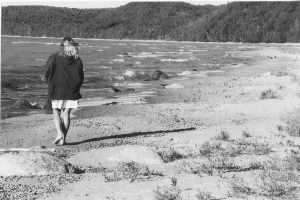
Yes, for sure. Also, living in Northern Michigan has given me a lot of time for reflection because I work solo, and I enjoy that. I enjoy walking on the beach solo, besides my dog, who doesn’t care much that I’m there and doesn’t talk to me.
What draws you to this work? Working in metal, and creating personal objects for a person to wear?
Working with my hands, and design. I’ve always loved design. I think it’s important to everything, whether it’s a gas station or an art gallery. I grew up having a deep appreciation for art, going to art shows in Atlanta, where I grew up. Back then, there weren’t that many art fairs, just a couple, but I’d go every year and buy a piece of art, and some of that I still have hanging on my wall. I wasn’t exposed to art growing up. I wasn’t taken to museums, but I loved art class. I loved learning how to work with my hands — knitting, gardening, cooking, sewing.
Sounds like, even as a little kid, you found ways to get yourself in places where you could absorb things that were of interest to you.
That’s true. And, I found it all interesting whether I liked it or not. I was always very curious about artists and their lifestyles, and how they made their living. And how you got there: I never thought I’d grow up and be a metalsmith. I’m still that little girl: Give me an art show on the weekend that I’m not participating in, and I’ll go to it, solo, and walk around and study everything.
Did you receive any formal training in visual art?
Little spurts of formal training. I did go to art school, the American College of Art. I studied graphic design for a minute. I studied fashion design for a minute. Both of those gave me good rendering experience, but I didn’t stay with that. I moved onto interior design. Everything was hand drawn then; we didn’t have computers.
When you moved to Glen Arbor, you went through a program of learning that was outside the university or college sphere. Why don’t you tell that story of how you got here, and what got you here.
I worked in a small jewelry gallery in Atlanta [Geode Limited Jewelry Designs], which represented 50 different metalsmiths, and there were 50 different windows. I did the displays in those windows, and knew most of the artists, and one of those artists was Becky Thatcher from Glen Arbor. Whenever she came in, I’d work with her. It was all on consignment. I’d sit with her and pick out pieces we thought would sell in the gallery. I worked at that gallery for four or five years. I turned in my notice because I wanted to go back to school full-time to study architecture. Becky got wind that I was retiring from that job, and said, Why don’t you come work for me in Glen Arbor? I’d never heard of Glen Arbor. So, I went to Glen Arbor [in the late 1980s], and worked for her from Memorial Day to Labor Day. I lived in the loft over her shop, and managed her galleries in Leland and Harbor Springs. I did the jewelry displays. But I didn’t make jewelry for her. I went back home to Atlanta for two weeks, and then decided I’m outta here. I’m going to move back up to that little town. And I’ve been here ever since.
The story behind how you taught yourself to make jewelry is very interesting — especially in the age of too much computer.
I’d never made jewelry, but I knew what you could and couldn’t do because we’d do a lot of custom work. With Becky, it was sort of the same thing. I had a base of education, but I’d never soldered anything. So, I went to the old library on Sixth Street in Traverse City [Michigan], and checked out three, super-old books from the 50s and 60s on jewelrymaking. I set up a work bench in my duplex that had new carpeting in it, and started soldering away. All the hot metal that would go flying would land on the carpet and burn a hole in a fish shape in the brand new carpet. I was self-taught from those library books.
The formal studies in which you engaged before you started making jewelry don’t seem to have any relationship to metalsmithing. Talk about making jewelry that’s of interest to you. What hooked you?
Working at Geode and Becky Thatcher Designs showed me I could make a living at this. The idea of working with metal, and being able to manipulate it — that was intriguing. I liked jewelry. I wasn’t — and still am not — a big jewelry wearer, but I have a fine appreciation for handmade work, whether it’s jewelry, clothing, anything. I put my love of design, and my knowledge of that, into jewelry making.
Given your living space at the time, jewelry making was something you could do in a small space. Now you have a very interesting studio.
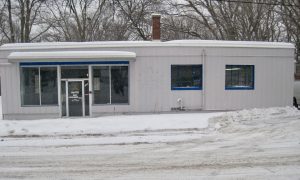
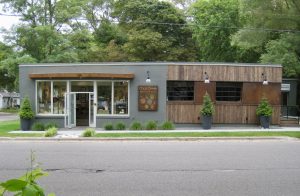
My studio now is wonderful. It’s old glass windows from the 40s. It’s the old boiler room of a drycleaning business I renovated years ago [the former Coddington Furriers and Cleaners building], and sits on a creek in downtown Traverse City. It has concrete floors, no carpeting; you can’t ruin anything in there. My first studio was my living room. And, then I was in an upstairs bedroom. I’ve worked in a basement. You make due with the money you have, and where you are. [Her current studio] is by far my best, happiest studio space [and measures 15’ x 20’].
What prompts the beginning of a project or composition?
I start out working on one piece at a time. If I like it, I try to do a run. Usually, the ideas come from what I am making, or have made. Sometimes they’re inspired by something I see. Sometimes I play a game with myself: If I go to a gallery and see something I like — it could be a painting, a lamp, a clay pitcher — I’ll say, Look at that. Remember it. And have it inspire you to make a piece of jewelry. Not to [copy] the clay pitcher, but to take a line of it [as inspiration]. I’m doing that a lot more, and it’s fun. But I can also [refer back] to a piece I’ve already made. A piece can have multiple lives as it goes through time: bigger, smaller, different stone, different hammer, different texture, different shape.
How much pre-planning do you do in advance of beginning a new project?
I don’t do a lot of pre-planning. I used to sketch a lot more. I don’t anymore; I get something in my head, and I execute it. But I also feel like I’ve been doing this long enough, so there are things in my brain from 10 or 20 years ago — and, if I flip through my sketchbook sometimes [her reaction is], Oh my gosh. Look at that. I thought of that 15 years ago, and I ended up doing that. I hadn’t even looked at the sketch, and I’m doing it.
Why is making things by hand important to you?
That’s a complicated questions these days. It has always been important to me because I’d much rather have something handmade than stamped out, commercially processed: coffee mugs, jewelry, plates, pillows, sweaters. It’s important for our hands and our brains to work together. It’s important for our culture, and our history as human beings. But now, what is handmade? Sitting down and knitting a sweater? Building a computer can be considered handmade — it’s gotten a little fuzzy. What do people consider to be art now? I don’t think handmade art is as appreciated as it used to be. You can get paintings that are a lot less expensive online, cool stuff, but they’re not painted with a brush.
You’re talking about all the artificial ways people can get something decorative for their homes. There are machines and AI stuff that spit it out. That has left a lot of people believing that that kind of making is legitimate when the kind of making you do used to be the rule, versus the exception. You’ve created this practice that’s built on making things by hand. Do you feel that you’re getting squeezed by the computerized world? Do people look at your stuff and say, Oh, that’s nice, but I can go on line and get it for two cents.
That’s another interesting question. With jewelry, and metalwork, you can tell the difference between handmade and not. Whereas some paintings and prints, you can’t. I’ve looked at art at Target and it looks great; but I don’t buy it. I think, too, the younger generation doesn’t have an appreciation for handmade because they’re exposed to so much, and so much of it is so inexpensive. Artists can’t compete with that. It’s difficult. I do feel fortunate [to be making] jewelry, and other metalwork. A lot of it can be designed by computers, and some robots are coming into metalsmiths’ studios, but that’s not as common. So, it’s complicated.
For people to appreciate the kind of work you do, one has to have a context for understanding it; or, some exposure to work made by hand, whether that’s having visited museums and art fairs as a kid or young adult. My perception is that we live in a time when the majority of what most people get in the way of Capital “I” Information is from the screen, which is a total abstraction. There are fewer opportunities and incentives for people to have an up-close, personal, direct experience with handmade work. That’s why I’m wondering, when you exhibit at an art fair, does it feel harder to get people interested in what you’re doing? People are always interested in jewelry, but, as you say, they can always go online.
I feel very fortunate because where we live, there are a lot of artists, and a lot of people support the arts still. When I do an art show, I have a semi-following and recognition because of all the years I’ve been doing art shows. If I moved here from another state without a following, who knows? But I do feel fortunate that I have a following, and certain people like my jewelry and support that. But the art shows aren’t what they used to be. They’re crowded, but people aren’t buying as much. Younger people just don’t have the appreciation for handmade work. Back in the day, people wanted to take home a little bit of Northern Michigan. They have their phones now, and take pictures of things.
Art fairs don’t form the entirety of your commercial base. You also have your work in galleries and other storefronts.
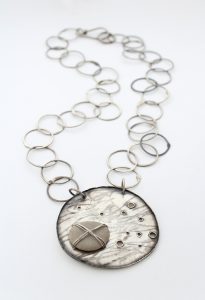
Correct. Art fairs used to be my main way to make money and engage with the public. That was good for me, to get me out the studio. Now, I might not even do any art shows next summer. It’s so much to go, set up, sell, tear down, and then you count your money, and you go, Ugh. Why not have it in a gallery, or a shop, where the exposure is greater.
What role does social media play in your practice?
It should play a lot more. Every day or every week I say, OK! OK! I’m going to post something besides [updates on her] dog. I need to use it more actively. I know I enjoy looking at what other people are making, and what they post. I know when I do post something [about her work], people remark. Even if you don’t get a sale from it, you’re getting exposure, and engagement. It’s tough. I’m at that age, on the balance of totally rejecting it and totally accepting. If I were 10 years younger [she’d feel that] everything [automatically] gets posted on Instagram and Facebook. I know I should be doing more of it — I’m at THAT age.
What do you believe is the visual artist’s role in the world?
How long do you have? I could talk about this forever. What’s our role? To continue making fine art, and exposing young people — whether by taking them to museums or galleries or teaching it in schools. The arts and people’s emotional makeup have gotten squashed. It has become irrelevant, when, in reality, I think it’s way more important than knowing any math equation. It’s who we are as people. We’ve created this world with our brains and our hands, and I think we’re rapidly getting rid of the aesthetics of that; getting rid of teaching people how to use their brains outside the box, outside the screen; to be able to think on their own and be on their own without constant outside input. It’s so important for human beings, and we’re going in the wrong direction. Keeping the arts alive is one of the most powerful things we can do for people, for young people especially. They’re going to grow up not knowing what to do with themselves if they don’t have a screen in their hand.
How does living in Northern Michigan inform and influence your practice?
We live in a beautiful area that attracts a lot of artists and people who like to be and live here because of its natural beauty. Moving up here way-back-when [Kim relocated to Northern Michigan in the late 1980s], it was a quieter place. Not as many people. That all inspired me. The beauty of the land inspired me. The people inspired me. It has grown so much — a lot in a good way, a lot — for me — not in a great way. I love the natural environment, and the support and diversity of the arts, the great galleries that show our work.
Did you know anyone when you were growing up who had a serious creative practice? A role model? Or, did you have to learn about that on your own?
My dad was creative in [the field of] advertising, and he was self-employed. That was a good example for me. My mother was very creative, always sewing, knitting. She could draw the heck out of a frog. She cooked, and she gardened. Still to this day, she would never say that she was an artist, but she really, truly was. She started a business sewing belts, and made thousands of dollars over several years while living at home and working in her little sewing room. Mom and Dad were my two, biggest examples.
Who has had the greatest and most lasting influence on your work and practice?
I can’t think of one person; I think the artistic community up here, in general. Some of that is because of how they’ve made their living, and some of that is because of what they make. [Many of these people] could have continued with 9-to-5 jobs and made a lot more money, but they chose this.
I like that you look at the creative community here as a whole. There are a lot of people who give us an example of how they approach doing their creative work. There are so many things one could take away from that, so you don’t have to reinvent the wheel on your own. There are plenty of people who are here to help.
Where or to whom do you go when you need honest feedback about your work?
My friend Melissa. If I don’t know about something, I’ll show her, and she is honest, honest, honest. And funny. It’s difficult to find someone who’s grounded and honest. Many will say, Oh, I LOVE it. That’s not always helpful.
Praise doesn’t always help.
[Constructive criticism] is hard to get. When I’m working in my studio, I don’t get out that often. So, I don’t get a lot of constructive criticism, and I miss that. It’s important. Also, it brings up new ideas. That’s a piece of the puzzle I’m missing right now.How do you feed/fuel/nurture your creativity?
I look at a few design magazines; I love architectural magazines — Architectural Digest, Decor, any of those. I love Vogue. Just going to a beautiful art gallery — I can stand there and feel the creative energy, and I know I’ve got to go back to work. And the more I work in my studio, the more I want to be there. That’s inspirational. If I’m in a [creative] funk, looking at something, like the lamp on my desk, and asking myself, What is that on your desk? Go to your studio and let that [the lamp] inspire something.
What drives your impulse to make?
I’ve had that ever since I was little: loving making clothes for my dolls, learning to knit. I was one of those kids who was taught knitting, and I thought, Oh my god, this is so much fun, and I can knit forever, and then I can tear it out and start all over again. That continued on. Are you born with it?
I think we’re all born with a lot of potential. And there are things that influence which of these potentials get more of our conscious attention, that keep on nagging us like a little kid tugging at the hem of a coat. So, yes, when you say it has been inside of you since you were a little kid, apparently it didn’t get crushed out of you when you became an adult.
I think if I’d stayed in Atlanta, I was either going to study architecture or international issues and go work for Coca Cola in Spain. Instead, that urge to move up here and leave all that behind, it was a decision I made that quick, and I’ve never been sorry about it. I ran away from a certain lifestyle, and into this lifestyle. Happily.
Read more about Kim Bazemore here.
Sarah Bearup-Neal develops and curates Glen Arbor Art Center exhibitions. She maintains a studio practice focused on fiber and collage.